AI-Optimised Website Design & Development
AI-Optimised Website Design & Development is a methodology for building websites that are engineered for both human users and AI search bots. It combines custom, conversion-focused design with AI-driven personalization, structured data, and continuous optimization to generate leads without large upfront fees. The result is an affordable custom website that acts as a 24/7 lead generation machine, visible across all search platforms.

Quick Answer
AI-Optimised Website Design & Development is a methodology for building websites that are engineered for both human users and AI search bots. It combines custom, conversion-focused design with AI-driven personalization, structured data, and continuous optimization to generate leads without large upfront fees. The result is an affordable custom website that acts as a 24/7 lead generation machine, visible across all search platforms.
Key Takeaways
AI-optimised websites are built with structured data and AEO-friendly formatting to rank in both Google and AI assistants like ChatGPT.
The model eliminates large upfront costs through a subscription, tying investment directly to ongoing performance and lead generation.
Visitor identification technology reveals which companies browse your site, enabling targeted, intent-based sales outreach.
Continuous AI-driven personalisation adjusts content and calls-to-action based on real-time visitor behaviour and intent signals.
Conversion-focused website designs are data-informed from the start, placing UX and lead capture above purely aesthetic considerations.
Technical performance like mobile-first responsiveness and fast load times is non-negotiable for both user experience and AI search ranking.
The system integrates seamlessly with CRM and marketing automation tools to create a closed-loop lead generation ecosystem.
Table of Contents
What Is AI-Optimised Website Design & Development?
AI-optimised website design and development is a holistic process of building and maintaining websites specifically engineered for AI-powered search engines and user personalisation. It combines technical ai search optimization, structured data, and conversion-focused design into a single, ongoing system. The result is an affordable custom website that actively generates leads by being perfectly formatted for modern AI bots and user intent.
Key Points:
- ✓Modern ai search optimization requires technical structuring for AI bots, not just keyword placement for traditional search algorithms.
- ✓An affordable custom website built with AI anticipates user intent and personalises content dynamically for higher conversion rates.
- ✓Continuous data analysis and algorithmic adjustments are fundamental to maintaining peak website performance in AI-driven search results.
- ✓Structured data markup provides essential context that helps AI understand and confidently feature your website's content.
- ✓True AI optimisation integrates lead capture mechanisms directly into the user experience based on real-time behavioural signals.
Action Steps:
- Audit your current website for AI bot crawlability, structured data implementation, and answer engine snippet potential.
- Prioritise building an affordable custom website on a platform that supports easy schema markup and headless CMS capabilities.
- Implement a content strategy focused on answering specific user questions with clear, scannable, and authoritative formatting.
- Integrate analytics to track not just traffic, but also engagement with dynamically personalised elements and conversion paths.
- Adopt a continuous improvement cycle using AI tools to test layouts, content, and technical performance monthly.
Problems AI-Optimised Website Design & Development Solves
AI-optimised website design solves the critical problem of building websites for outdated search paradigms. It addresses the high cost and poor ROI of traditional sites by engineering them for modern AI search optimization and user personalization from inception. This approach transforms a website from a static brochure into an intelligent, continuously improving lead generation system.
Key Points:
- ✓Traditional websites designed only for Google often fail under modern AI search optimization, becoming invisible to new answer engines.
- ✓High upfront costs for custom web design rarely deliver ROI when the site cannot identify or convert anonymous visitors.
- ✓Separate, ongoing SEO services add significant expense without guaranteeing alignment with evolving AI search algorithms.
- ✓Beautiful but static websites lack the dynamic personalization needed to engage visitors based on their real-time intent.
- ✓Slow, non-mobile-friendly sites with poor technical health are penalized by both user experience and AI search optimization.
Action Steps:
- Audit your current website for technical flaws and poor alignment with modern AI search optimization principles.
- Replace static brochure-ware with a conversion-focused structure engineered for both user intent and AI bot comprehension.
- Implement foundational AI search optimization elements like structured data and AEO-friendly content formatting immediately.
- Integrate visitor identification technology to capture leads and personalize content dynamically for higher conversion rates.
- Adopt a continuous improvement model using performance data to refine your site's AI search optimization monthly.
Benefits of AI-Optimised Website Design & Development
AI-optimised website design delivers superior lead generation by engineering sites for both user experience and AI bot comprehension. This approach provides a sustainable competitive advantage through continuous performance improvements and integrated personalisation. It ultimately creates a more affordable custom website that functions as a complete, self-optimising marketing system.
Key Points:
- ✓AI-optimised websites achieve higher search rankings by structuring content specifically for AI bot comprehension and evaluation.
- ✓Continuous ai search optimization post-launch adapts your site to algorithm changes, protecting your search visibility investment.
- ✓Dynamic personalisation engines use visitor intent data to display tailored content, significantly boosting conversion rates.
- ✓Integrated performance monitoring identifies technical issues instantly, preventing traffic loss from core web vitals penalties.
- ✓The subscription model spreads costs over time, creating a more predictable and affordable custom website investment.
Action Steps:
- Audit your current website for AI bot crawlability and structured data implementation gaps immediately.
- Prioritise building a new site on a platform engineered for continuous ai search optimization and easy updates.
- Implement a visitor identification system to capture intent data for dynamic personalisation and lead scoring.
- Schedule monthly performance reviews using integrated analytics to guide data-driven content and technical optimisations.
- Transition from large upfront fees to a subscription model that includes ongoing optimisation for predictable budgeting.
How AI-Optimised Website Design & Development Works
AI-optimised website design is a systematic process that builds a complete lead generation system. It implements ai search optimization for AI bots and answer engines while dynamically personalising user experiences to maximise conversions.
Key Points:
- ✓AI-optimised design requires a clear business strategy and defined target audience before technical implementation begins.
- ✓The core process integrates custom design with structured data and AI-driven personalisation from the ground up.
- ✓Seamless integration connects your new website to existing CRM, email, and analytics tools for unified data flow.
- ✓Continuous monitoring tracks user behaviour and AI search performance to fuel ongoing optimisation and scaling.
- ✓A successful AI-optimised website functions as a self-improving system that generates measurable ROI over time.
Action Steps:
- Audit your current website for technical performance, content structure, and existing lead generation capabilities.
- Define clear conversion goals and target customer personas to guide the AI personalisation strategy.
- Select a development partner offering a subscription model with ongoing ai search optimization and maintenance.
- Prepare your brand assets and content strategy to feed the AI content engine during the build phase.
- Plan the integration of your new AI-optimised website with existing marketing and sales technology stacks.
Essential Prerequisites for Implementation
Before implementing AI search optimization, establish clear business goals and audit your current digital assets. This ensures the AI has the right data and direction to personalize effectively.
Key Points:
- ✓Define your value proposition and target audience first to guide the AI.
- ✓Audit your website, content, and analytics to provide a performance baseline.
- ✓Secure brand assets and tool access for smooth, integrated implementation.
Action Steps:
- Document your core conversion goals and ideal customer profiles.
- Conduct a full audit of your website's content, speed, and analytics setup.
- Gather brand guidelines and ensure access to key marketing platforms.
Core Process: Step-by-Step System Build
The AI-optimised website build is a three-phase process that layers AI capabilities onto a robust technical foundation, moving from strategy to core development to AI-specific optimisation.
Key Points:
- ✓The process is structured in clear, sequential phases to ensure a solid foundation before adding AI layers.
- ✓The final phase is critical, focusing on technical SEO and structured data to make the site visible to AI bots and search engines.
- ✓The entire build is designed for mobile-first performance and conversion optimisation from the start.
Action Steps:
- Begin with strategy sessions to map user journeys and define AI personalisation rules.
- Develop a high-speed, mobile-first website core with conversion-optimised layouts.
- Implement the AI search layer with schema markup and AEO-friendly content formatting.
Seamless Integration with Existing Tools
We ensure your AI-optimised website integrates directly with your CRM, email, and analytics tools to centralise data and automate lead capture.
Key Points:
- ✓Connects website data to your CRM for sales-ready leads.
- ✓Eliminates data silos between your website and marketing stack.
- ✓Automates the flow of visitor intent data to your sales team.
Action Steps:
- Audit your current CRM and analytics tools for compatibility.
- Define key buying signals to feed from the website to your CRM.
- Plan integration phases during the website build process.
Continuous Monitoring and Scaling Strategy
Post-launch, your website becomes a data-driven system where AI monitors performance and user behavior to continuously optimize for conversions and engagement through monthly refinement cycles.
Key Points:
- ✓AI dashboards track KPIs for search, engagement, and conversions to guide decisions.
- ✓Heatmaps and user flow analysis identify friction points for A/B testing.
- ✓Monthly cycles refine personalization and enhance top-performing content.
Action Steps:
- Deploy AI dashboards to monitor key performance indicators.
- Analyze user behavior data monthly to identify optimization opportunities.
- Implement a regular cycle to test, tweak, and expand successful elements.
How to implement AI search optimization on your website (step-by-step)
Implement AI search optimization through a three-step process: audit your technical SEO, add structured data markup, and reformat content for AI readability.
Key Points:
- ✓Requires both technical fixes and content restructuring.
- ✓Structured data is critical for AI to understand your pages.
- ✓Content must be clear, scannable, and answer-focused.
Action Steps:
- Audit page speed, mobile responsiveness, and sitemap.
- Implement schema markup (e.g., Product, FAQPage).
- Reformat core content using AEO-friendly principles.
How to build an affordable custom website with AI (step-by-step)
Build an affordable custom website with AI by partnering with a subscription-based agency. They handle design, development, and ongoing AI optimization for a predictable monthly fee.
Key Points:
- ✓AI website builders use subscriptions to avoid large upfront costs.
- ✓The process includes a collaborative strategy phase and builds on flexible platforms like WordPress.
- ✓Ongoing AI search optimization is included to maintain performance.
Action Steps:
- Select an agency with a monthly subscription covering design, dev, hosting, and AI SEO.
- Collaborate on a strategy to define your brand, audience, and core pages.
- Use the agency's AI tools for mood boards and ensure the site is built on an easy-to-update platform.
How to design a conversion-focused website using AI (step-by-step)
Use AI to predict user attention during wireframing, create testable design variations, and implement dynamic content personalisation to boost conversions.
Key Points:
- ✓AI predicts high-impact areas before you build.
- ✓Design for ongoing AI-powered A/B testing.
- ✓Personalise content dynamically for visitors.
Action Steps:
- Use AI heatmap tools in wireframing.
- Design multiple CTA/hero variants for testing.
- Implement a dynamic content engine.
How to integrate AI personalization into your lead generation system (step-by-step)
Integrate AI personalization by installing visitor identification tools, configuring dynamic content rules in your CMS, and connecting to your CRM to transform anonymous traffic into qualified leads.
Key Points:
- ✓AI personalization turns anonymous visitors into identified prospects using firmographic data.
- ✓Dynamic content rules automatically serve tailored messaging to increase conversion.
- ✓CRM integration ensures lead data flows directly into your sales pipeline.
Action Steps:
- Install a visitor identification tool to reveal company data.
- Configure dynamic content rules in your CMS for tailored messaging.
- Set up CRM integration to automatically capture and route leads.
How to measure the ROI of an AI-optimised website (step-by-step)
Measure AI website ROI by tracking direct revenue from AI search traffic and calculating efficiency gains from reduced manual work. Compare post-implementation metrics against your established baseline.
Key Points:
- ✓Track both revenue attribution and operational efficiency gains.
- ✓Use UTM parameters and closed-loop analytics for precise traffic measurement.
- ✓Quantify time and cost savings from automated content updates.
Action Steps:
- Establish baseline metrics for cost per lead and acquisition cost.
- Implement tracking to attribute leads/sales to AI search traffic.
- Monitor reductions in manual content update time and costs.
How to maintain and scale your AI-driven website (step-by-step)
Maintain and scale your AI-driven website through scheduled technical upkeep and data-driven content expansion. This ensures ongoing performance, security, and relevance to both users and search algorithms.
Key Points:
- ✓Proactive, scheduled maintenance (monthly, quarterly, bi-annually) is essential for performance and security.
- ✓Use AI tools for content gap analysis to identify and target new audience search intents.
- ✓Regularly review and optimise personalisation and conversion pathways to improve lead generation.
Action Steps:
- Implement a monthly checklist for CMS updates, speed checks, and security monitoring.
- Quarterly, use AI analysis to publish new AEO-optimised content targeting identified gaps.
- Bi-annually, audit and refine on-site personalisation rules and conversion funnels.
AI-Optimised Website Design & Development Tools & Features
AI-optimised website tools and features are specialized components built for ai search optimization and user personalization from the start. They include technical frameworks for speed and structured data, content systems formatted for AI comprehension, and dynamic personalization engines that identify visitor intent. This integrated stack ensures your affordable custom website functions as a intelligent, self-improving lead generation system, not just a digital brochure.
Key Points:
- ✓Core ai search optimization tools automatically generate and implement schema markup for every page and piece of content.
- ✓An integrated AEO Content Engine structures information with clear hierarchies and semantic formatting for AI bots.
- ✓Visitor Identification technology anonymously tracks company data and intent signals from every website visitor in real-time.
- ✓Dynamic Personalisation modules alter page content and calls-to-action based on the identified visitor's profile and behaviour.
- ✓Continuous performance monitoring tools track core web vitals, conversion paths, and AI search ranking fluctuations automatically.
Action Steps:
- Audit your current website for missing structured data and poor page speed scores critical for ai search optimization.
- Prioritise platforms with built-in AEO content formatting and automatic schema generation over basic page builders.
- Implement a visitor identification system to capture company data and buying signals from anonymous traffic.
- Configure dynamic content rules to personalise messaging for different visitor segments identified by the AI.
- Establish a monthly review cycle for performance data from your AI-optimised website's analytics and monitoring suite.
AI-Optimised Website Design & Development Costs & ROI
The investment for an AI-optimised website typically follows a monthly subscription model starting from £500-£1,500+, eliminating large upfront fees. The ROI is driven by transforming your website into a 24/7 lead generation system, with many clients achieving payback within 3-6 months through increased qualified leads and reduced marketing waste.
Key Points:
- ✓The subscription model replaces risky £10k+ upfront costs with predictable, performance-aligned investment.
- ✓ROI is calculated on lead value, not just website cost—focus on the revenue generated by the system.
- ✓The greatest cost is often the opportunity cost of delaying, as a non-performing website leaks revenue daily.
- ✓Long-term value comes from continuous AI optimisation, keeping your site ahead of search and conversion trends.
Action Steps:
- Audit your current website's lead generation performance and monthly lead value.
- Calculate the potential monthly lead increase an AI-optimised site could deliver against the subscription cost.
- Evaluate the hidden costs of your current site: lost leads, slow builds, and separate SEO/tech fees.
- Project a 12-24 month ROI scenario comparing the subscription model to traditional web design costs.
AI-Optimised Website Design & Development Use Cases
AI-optimised website design applies artificial intelligence across multiple use cases to transform a site into an active lead generation engine. Key applications include personalising user experiences in real-time, optimising content for AI search platforms, and automating visitor identification for sales teams. This approach ensures your affordable custom website continuously learns and improves, directly addressing the pain points of high upfront costs and poor ROI.
Key Points:
- ✓Traditional websites fail to identify anonymous visitors, missing critical sales opportunities from high-intent traffic.
- ✓Static content cannot personalise user experiences, leading to higher bounce rates and lower conversion potential.
- ✓Manual SEO efforts become obsolete against AI search platforms that prioritise deeply structured, authoritative content.
- ✓Separate development costs for updates create dependency and delay crucial marketing optimisations for months.
- ✓A one-time website build lacks the data feedback loop required for continuous performance improvement and growth.
Action Steps:
- Audit your current website for gaps in personalisation, structured data, and integration with your CRM system.
- Prioritise building a website with embedded AI tools for real-time visitor identification and behavioural tracking.
- Implement a content management system that supports AEO-friendly formatting and automatic schema markup generation.
- Adopt a subscription model that includes ongoing ai search optimization and technical performance updates.
- Integrate your website directly with email marketing and sales outreach platforms to automate lead nurturing.
Best Practices for AI-Optimised Website Design & Development
Best practices for AI-optimised website design centre on structuring your site for both human users and AI bots through technical and content strategies. This involves implementing schema markup, ensuring fast load times, and creating AEO-friendly content to maximise visibility in AI-driven search. The goal is to build an affordable custom website that acts as a perpetual lead generation system, not just a visual portfolio.
Key Points:
- ✓AI search optimization demands structured data implementation so AI bots can accurately parse and categorise your website's content and services.
- ✓Fast-loading, mobile-first technical foundations are non-negotiable for both user experience and AI bot crawl efficiency during indexing.
- ✓Content must be formatted for answer engines with clear hierarchies, direct answers, and semantic relevance to user search intent.
- ✓Continuous performance monitoring and data-driven iteration are essential to maintain and improve your site's AI search ranking over time.
- ✓An affordable custom website built for AI integrates lead capture and visitor identification directly into its optimised architecture.
Action Steps:
- Audit your current site for structured data gaps and implement comprehensive schema markup for products, services, and FAQs.
- Prioritise Core Web Vitals by optimising images, leveraging browser caching, and using a content delivery network for global speed.
- Rewrite key service pages using AEO-friendly formatting with clear question-and-answer structures and concise, authoritative paragraphs.
- Deploy analytics to track AI-driven traffic patterns and user behaviour for monthly optimisation of content and conversion paths.
- Integrate a smart lead capture system that identifies anonymous website visitors and scores their buying intent in real-time.
How to Implement AI-Optimised Website Design & Development
Implement AI-optimised website design by first preparing your strategy and assets, then following a phased build process that integrates ai search optimization from the ground up. Configure personalisation and tracking before rigorously testing all technical and conversion elements prior to launch.
Key Points:
- ✓A comprehensive preparatory phase defining audience intent and KPIs is the non-negotiable foundation for a successful AI-optimised build.
- ✓Phased implementation embeds ai search optimization techniques like semantic coding into the website's core architecture from the start.
- ✓Detailed schema markup configuration for services and local business information dramatically improves AI bot comprehension and ranking potential.
- ✓Rigorous pre-launch testing of technical performance and conversion pathways ensures your website reliably generates leads from day one.
- ✓Continuous post-launch monitoring and optimisation based on real user data are what sustain long-term ai search optimization success.
Action Steps:
- Define your lead generation KPIs and conduct a full audience intent analysis before any design or development work begins.
- Choose a development partner who embeds semantic HTML and schema markup during the core build phase, not as an afterthought.
- Configure dynamic content personalisation rules based on visitor behaviour to increase engagement on your key service pages.
- Validate all technical SEO elements and structured data using Google's official testing tools prior to website launch.
- Establish a monthly review process to analyse performance data and iteratively optimise content and conversion paths.
Prerequisites: What You Need Before Starting
Prepare by auditing your digital assets and defining clear lead generation KPIs before building. Gather all brand materials and technical requirements upfront.
Key Points:
- ✓A thorough audit of existing assets prevents redundant work.
- ✓Clear KPIs for lead generation must be set before development begins.
- ✓Having all brand and technical assets ready accelerates the build.
Action Steps:
- Audit your current website, content, and brand guidelines.
- Define specific lead generation objectives and KPIs (e.g., form submissions).
- Compile logos, colour palettes, and technical requirements in one place.
Step-by-Step Implementation Process
Implement AI-optimised websites through a phased process starting with strategy and architecture, followed by custom development with integrated AI search coding.
Key Points:
- ✓Phase-based methodology ensures strategic alignment and efficiency
- ✓Core AI search optimisation is built directly into the development phase
Action Steps:
- Begin with Phase One: map user journeys and create a dual-optimised sitemap
- Proceed to Phase Two: develop mobile-first layouts with coded AI optimisation techniques
Configuration and Customisation Guide
Configure your site by customising layouts for key pages and implementing structured data to make it uniquely tailored for your business and understandable by AI bots.
Key Points:
- ✓Customise conversion-optimised layouts for key service/product pages.
- ✓Implement detailed schema markup (local business, products, FAQs) for AI understanding.
- ✓Configure Visitor Identification to capture buying intent.
Action Steps:
- Start with key pages: tailor layouts with clear CTAs and value propositions.
- Add structured data for local info, products, and FAQs.
- Set up the Visitor Identification system.
Testing and Validation Protocol
A structured testing protocol validates your AI-optimized site's technical performance and conversion pathways, ensuring it functions as a reliable lead generation system.
Key Points:
- ✓Validation ensures your site works for both users and AI bots, not just search engines.
- ✓Testing must cover technical SEO, structured data, and all conversion points across devices.
Action Steps:
- Audit core web vitals and indexation with Google Search Console and Lighthouse.
- Manually test every form, button, and chat widget on multiple browsers and devices.
AI-Optimised Website Design & Development FAQs
AI-Optimised Website Design & Development Buyer's Guide
This buyer's guide provides a structured framework for selecting an AI-optimised website provider. It covers key priorities, essential questions to ask vendors, warning signs to avoid, and specific evaluation criteria to ensure your investment functions as a complete lead generation system, not just a digital brochure.
Key Points:
- ✓Prioritise ongoing AI search optimisation and personalisation over one-time design aesthetics.
- ✓Demand transparency in pricing models and avoid large upfront fees with no performance guarantees.
- ✓Evaluate providers based on their technical implementation of structured data and AI bot compatibility.
- ✓Ensure the platform includes visitor identification and integrates seamlessly with your marketing stack.
- ✓Choose a partner focused on continuous improvement through data, not just a launch-and-leave service.
Action Steps:
- Step 1: Audit your current website's performance gaps in AI search visibility and lead conversion.
- Step 2: Create a shortlist of 3-5 providers specialising in AI-optimised development, not just standard SEO.
- Step 3: Schedule discovery calls and use the questions in this guide to vet each provider's methodology and results.
- Step 4: Request case studies or pilot projects that demonstrate ROI in lead generation, not just traffic increases.
- Step 5: Finalise your decision based on a combination of technical capability, commercial model alignment, and strategic partnership potential.
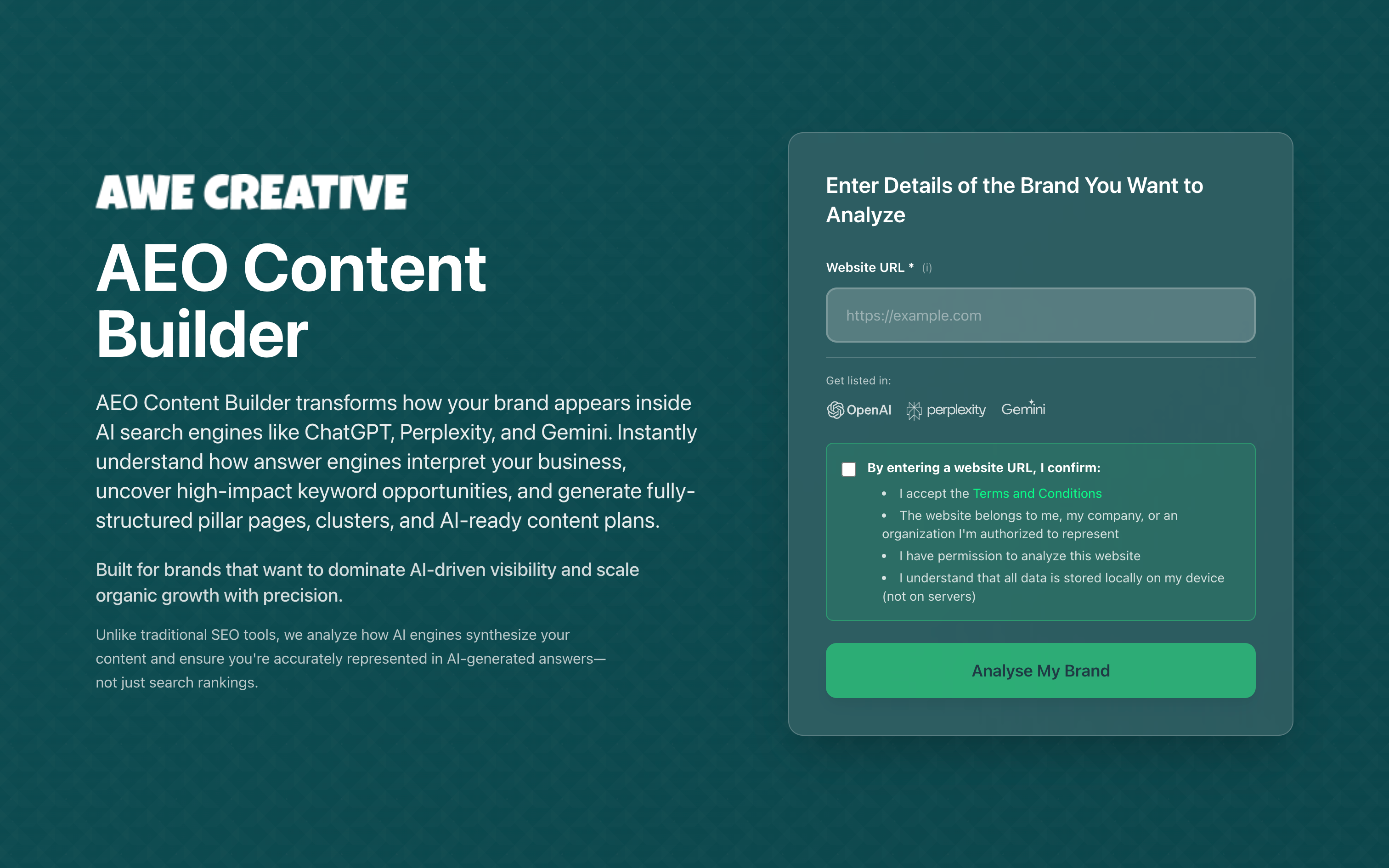
AEO Content Builder
Just enter your website address and we'll do the rest. Instantly understand how AI search engines interpret your business and generate AI-ready content plans.
✓ Enter your website URL
✓ Get instant AI analysis
✓ Receive your content strategy
No credit card required • Instant analysis
Deep Dive Topic
Explore this comprehensive guide that dives deeper into conversion-focused website design best practices
Complete Guide to AI-Optimised Website Design & Development
Everything you need to know about building conversion-focused websites that perform in AI search and generate leads 24/7.
Related Articles
Ready to Optimize Your Content for AI Search?
Let's discuss how AEO can transform your lead generation strategy.
Ready to get started?
Get Your AEO Implementation ChecklistTrack your progress step-by-step with our comprehensive checklist