AI Search & Answer Engine Optimization
Answer Engine Optimization is the practice of optimizing content for AI-powered search engines that provide direct answers rather than traditional search results, focusing on structured data, natural language processing, and technical implementation to capture featured snippets and voice search visibility.
Quick Answer
Answer Engine Optimization is the practice of optimizing content for AI-powered search engines that provide direct answers rather than traditional search results, focusing on structured data, natural language processing, and technical implementation to capture featured snippets and voice search visibility.
Key Takeaways
AEO focuses on providing direct, conversational answers to user queries rather than traditional SEO ranking
Structured data and schema markup are essential for AI search engines to understand and feature your content
Voice search optimization requires natural language patterns and question-based content structure
Measuring AEO success requires tracking featured snippet performance and voice search rankings
Table of Contents
In today's rapidly evolving digital landscape, traditional SEO is no longer sufficient to capture valuable search traffic. As AI-powered search environments like voice assistants, chatbots, and answer engines become the primary way users find information, businesses face a critical challenge: optimizing for these new platforms or risking irrelevance. Answer Engine Optimization (AEO) represents the next evolution in search strategy, focusing on delivering direct, authoritative answers that AI systems prioritize. This comprehensive guide explores how B2B service providers and local businesses can adapt their content strategies to thrive in AI-driven search environments. We'll cover everything from fundamental AEO principles to advanced implementation techniques, helping you transform your digital presence from a pretty website with ugly results into a lead-generating machine that captures the growing market of AI search users. Whether you're struggling with low conversion rates from organic traffic or watching competitors capture market share while you optimize for outdated search methods, this pillar page provides the actionable strategies needed to succeed in the age of AI search.
What is Answer Engine Optimization (AEO)?
Answer Engine Optimization (AEO) is the practice of optimizing content to be selected as direct answers in AI-powered search platforms like voice assistants and chatbots. Unlike traditional SEO that focuses on website rankings, AEO aims to position your content as the featured answer within the search interface itself.
Key Points:
- ✓AEO focuses on delivering direct answers rather than driving clicks
- ✓Optimizes for AI systems that prioritize concise, authoritative content
- ✓Represents the evolution beyond traditional SEO methods
Action Steps:
- Audit existing content for AEO potential
- Identify common questions in your industry that need direct answers
- Begin restructuring content to answer specific user queries
Defining AEO
Answer Engine Optimisation (AEO) is the practice of structuring content so that AI systems can instantly extract and deliver it as the definitive answer to a user's question. It focuses on producing concise, authoritative responses that AI can easily interpret and trust.
Key Points:
- ✓AEO is about answer extraction, not link ranking
- ✓Prioritises clarity, structure, and authoritative content
- ✓Aligns content with natural-language queries
- ✓Optimises for AI models used in chat, voice assistants, and search interfaces
Action Steps:
- Identify key questions your audience genuinely asks
- Create direct, clearly written answer-first content
- Use structured formats such as definitions, lists, and FAQs
- Ensure authority signals by referencing experience, data, or industry insight
How AEO Differs from Traditional SEO
Traditional SEO aims to rank web pages on search results pages, whereas AEO focuses on having your content selected as the direct answer within AI-driven search experiences. SEO drives clicks, while AEO aims to deliver value immediately within the search or conversational interface.
Key Points:
- ✓SEO focuses on visibility through rankings; AEO focuses on accuracy and trust
- ✓SEO prioritises keywords; AEO prioritises natural-language answers
- ✓AEO content must be concise, structured, and unambiguous
- ✓Success metrics differ: clicks vs answer selection
Action Steps:
- Review existing high-value pages and rewrite sections to provide direct answers
- Reduce unnecessary copy and ensure each section begins with a summarised response
- Map your content to natural-language questions rather than individual keywords
- Implement FAQ-style sections and schema markup where appropriate
The Evolution from SEO to AEO
As search behaviour has shifted towards conversational queries and AI-generated responses, optimisation has evolved from keyword-based SEO towards AEO, which ensures your content is selected as the authoritative answer within AI-driven environments.
Key Points:
- ✓User behaviour has shifted from keywords to full questions
- ✓AI systems synthesise answers instead of listing links
- ✓AEO reflects how modern search engines now operate
- ✓Businesses must adapt content to remain visible in AI-led search
Action Steps:
- Audit content for long, unfocused sections; replace them with answer-first blocks
- Identify industry questions users commonly ask in conversational form
- Align content structure with how AI breaks queries into sub-questions
- Update or expand content to match emerging AI search patterns
Core Principles of Answer Engine Optimization
The core principles of AEO include establishing authority signals AI systems trust, directly answering user questions with clear responses, and implementing structured data to help AI understand and extract your content for direct answers.
Key Points:
- ✓Authority building is crucial for AEO success
- ✓Direct question answering outperforms broad topic coverage
- ✓Structured data implementation enhances AI content understanding
Action Steps:
- Implement FAQ schema on relevant pages
- Restructure content to answer specific questions directly
- Build authority through comprehensive topic coverage
Authority and Trust Signals
Authority and trust signals help AI systems determine whether your content is reliable enough to serve as a direct answer. These signals come from demonstrating expertise, providing accurate information, and maintaining consistent, high-quality coverage of your subject area.
Key Points:
- ✓AI prioritises authoritative sources when selecting answers
- ✓Expertise, accuracy, and consistency strongly influence trust
- ✓Comprehensive topical coverage signals depth and reliability
- ✓External references and citations reinforce content credibility
Action Steps:
- Create in-depth content clusters that demonstrate expertise
- Reference reputable sources and include supporting evidence
- Maintain consistency across all related content
- Ensure factual accuracy and keep information up-to-date
Direct Question Addressing
Direct question addressing means structuring your content to answer specific user questions clearly and concisely, ensuring AI systems can immediately extract the response without scanning long paragraphs.
Key Points:
- ✓Answers must appear at the top of each section
- ✓Clarity is more important than length
- ✓AI prefers explicit question-and-answer formatting
- ✓Avoid vague or overly narrative introductions
Action Steps:
- Begin each major section with a one-to-three-sentence answer
- Ensure every page covers clearly defined user questions
- Use headings that mirror real search queries
- Write with minimal fluff and maximum clarity
Structured Data Implementation
Structured data helps AI systems interpret your content's purpose and context, making it easier for them to extract your information as a direct answer to user queries.
Key Points:
- ✓Schema markup provides machine-readable clarity
- ✓FAQ, How-To, and Q&A schema are highly effective for AEO
- ✓Structured hierarchies improve scanability for AI
- ✓Clear headings and lists support answer extraction
Action Steps:
- Implement FAQ schema for pages containing common questions
- Use How-To schema where procedural guidance is provided
- Structure content with logical headings (H2 → H3 → H4)
- Add lists, tables, and concise definitions for machine readability
Implementing AEO Fundamentals for Your Business
Implement AEO by auditing existing content for featured snippet potential, creating question-focused content that directly answers user queries, and implementing technical elements like schema markup and proper content structure that AI systems prefer.
Key Points:
- ✓Start with content audit to identify AEO opportunities
- ✓Create question-focused rather than topic-focused content
- ✓Technical implementation is crucial for AEO success
Action Steps:
- Conduct comprehensive content audit for AEO potential
- Implement FAQ and Q&A schema markup
- Create content calendar focused on question-based topics
Content Audit and Restructuring
Question-Focused Content Creation
Technical AEO Implementation
Common AEO Mistakes to Avoid
Common AEO mistakes include over-optimizing content artificially, poor content structure that hides answers, technical errors in schema implementation, and treating AEO as a one-time project rather than ongoing strategy.
Key Points:
- ✓Avoid over-optimization that appears manipulative
- ✓Ensure proper content structure for AI readability
- ✓Technical implementation requires ongoing attention
Action Steps:
- Audit existing content for over-optimization issues
- Implement proper heading hierarchies and content structure
- Establish regular content refresh schedule for AEO pages
Over-Optimization Pitfalls
Content Structure Errors
Technical Implementation Mistakes
Next Steps: Evolving Your Strategy with AEO
Evolve your AEO strategy by adopting continuous optimization, integrating AEO with overall marketing efforts, and developing proper measurement frameworks that track AEO-specific success metrics beyond traditional SEO.
Key Points:
- ✓AEO requires continuous optimization, not one-time implementation
- ✓Integration with overall marketing strategy enhances results
- ✓Proper measurement frameworks are crucial for AEO evolution
Action Steps:
- Establish regular AEO performance review schedule
- Integrate AEO tracking with overall marketing analytics
- Develop AEO-specific success metrics beyond traditional SEO
Continuous Optimisation Approach
AEO is not a one-off implementation; it requires continual refinement to keep your content aligned with evolving AI systems, shifting user behaviour, and new search trends.
Key Points:
- ✓AEO performance changes as AI models evolve
- ✓Regular content updates improve answer selection consistency
- ✓Monitoring emerging questions uncovers new optimisation opportunities
- ✓Continuous improvement outperforms one-time optimisation
Action Steps:
- Review high-value content every 60–90 days
- Track which pages are being cited or summarised by AI tools
- Update answers to reflect industry changes and new user questions
- Maintain a rolling AEO content refresh calendar
Integrating AEO with Overall Marketing
AEO performs best when fully integrated into your wider marketing strategy, ensuring that answer-led content supports brand positioning, lead generation, and ongoing engagement.
Key Points:
- ✓AEO should complement SEO, content marketing, and demand generation
- ✓Answer-first content can introduce prospects at the top of the funnel
- ✓Seamless pathways from AI-delivered answers to deeper engagement are essential
- ✓AEO strengthens every stage of the customer journey
Action Steps:
- Map AEO content to your existing funnel stages
- Develop deeper resources linked to high-performing AEO answers
- Align product messaging with AEO topics and FAQs
- Ensure marketing analytics reflect AEO-driven user journeys
Measuring AEO Success Metrics
AEO requires its own measurement framework focused on answer visibility, AI content utilisation, and engagement paths, rather than relying solely on traditional SEO metrics like rankings and organic traffic.
Key Points:
- ✓Ranking alone does not reflect AEO performance
- ✓Answer appearance, citation frequency, and AI extraction are key indicators
- ✓Voice search performance is increasingly important
- ✓Measurement should include downstream engagement and conversion impact
Action Steps:
- Track featured snippets, answer boxes, and "position zero" placements
- Monitor citations across AI search tools and generative engines
- Use voice search analytics where available
- Analyse user behaviour after interacting with AI-generated answers
What is AI Search Optimization and Why It Matters Now
AI Search Optimization optimizes content for AI-powered search platforms like enhanced search engines, voice assistants, and chatbots. It matters now because AI search is rapidly replacing traditional search, and businesses that don't adapt risk losing visibility and market share.
Key Points:
- ✓AI Search Optimization targets how AI systems understand and present content
- ✓Represents fundamental shift from website listings to direct answers
- ✓Critical for maintaining visibility as search behavior evolves
Action Steps:
- Conduct AI search landscape analysis for your industry
- Identify key AI search platforms relevant to your audience
- Begin content optimization for AI understanding and extraction
Defining AI Search Optimization
AI Search Optimization is the practice of structuring and writing content so AI systems—such as generative search engines, voice assistants, and chatbots—can understand, extract, and present your information as authoritative answers.
Key Points:
- ✓Focuses on how AI interprets, evaluates, and selects content
- ✓Goes beyond keywords into meaning, intent, and structure
- ✓Requires optimising for natural language queries and direct answers
- ✓Aligns content with the way AI models generate responses
Action Steps:
- Optimise content for natural language questions, not just keyword phrases
- Add clear answer blocks at the top of content
- Ensure content is factually consistent and context-rich
- Use structured data where appropriate to enhance content parsing
The Shift from Traditional Search
Search behaviour has shifted from typing keywords into search engines toward asking complete questions to AI assistants—meaning AI systems now deliver direct answers rather than directing users to websites.
Key Points:
- ✓Users now expect instant answers, not lists of links
- ✓AI-generated responses reduce dependency on traditional ranking
- ✓Conversational queries replace keyword-based searches
- ✓Visibility depends on becoming the source for AI answers
Action Steps:
- Identify high-value questions your audience asks today
- Create answer-first content targeting conversational search patterns
- Optimise content for both text-based and voice-based AI interactions
- Reduce reliance solely on ranking and organic traffic metrics
Business Impact of AI Search
AI Search Optimization directly influences brand visibility, lead generation, and competitive positioning by ensuring your content is selected as the authoritative answer within AI-driven search environments.
Key Points:
- ✓Being chosen as an AI answer increases authority and trust
- ✓Businesses not optimised for AI risk losing visibility entirely
- ✓AI search influences the full customer journey, especially early research
- ✓AI-optimised content converts better because it aligns with real user intent
Action Steps:
- Audit AI visibility: check how often your brand appears in AI answers
- Identify competitors dominating AI-generated responses
- Build content that directly addresses high-intent queries
- Track conversions originating from AI search paths
Core AI Search Optimization Strategies
Core AI Search Optimization strategies include natural language optimization matching how people speak, enhancing contextual understanding through comprehensive content, and multi-platform optimization for different AI search environments like voice, chatbots, and enhanced search.
Key Points:
- ✓Natural language optimization matches AI processing patterns
- ✓Contextual understanding requires comprehensive topic coverage
- ✓Multi-platform optimization addresses different AI search environments
Action Steps:
- Audit content for natural language alignment
- Develop comprehensive content clusters around core topics
- Implement platform-specific optimization for different AI search interfaces
Natural Language Optimization
Natural Language Optimization aligns your content with the way people naturally speak and ask questions, ensuring AI systems can easily interpret, extract, and deliver your answers.
Key Points:
- ✓AI systems favour conversational, human-like phrasing
- ✓Full-sentence, context-rich content performs better than keyword stuffing
- ✓Query-first structures (answer → context → expansion) improve AI extraction
- ✓Natural language supports both voice queries and generative search models
Action Steps:
- Rewrite key pages using conversational, human-centred language
- Use complete sentences rather than keyword fragments
- Add question-and-answer formatting for clarity and extractability
- Include synonyms and semantically related phrases naturally within content
Contextual Understanding Enhancement
Contextual Understanding Enhancement involves building comprehensive, semantically rich content that helps AI systems interpret relationships, entities, and topical depth.
Key Points:
- ✓AI ranks content based on depth, breadth, and semantic clarity
- ✓Entity-based optimization improves AI comprehension
- ✓Strong internal linking strengthens contextual signals
- ✓Topic clusters help AI understand expertise and content relationships
Action Steps:
- Build content clusters around your core topics
- Use semantic keywords, related concepts, and entity references
- Add clear explanations of people, products, processes, and definitions
- Strengthen internal linking to show how topics connect
Multi-Platform AI Optimization
Multi-Platform AI Optimization ensures your content performs effectively across all AI search environments—including voice assistants, chatbots, generative search engines, and traditional AI-enhanced search results.
Key Points:
- ✓Each AI platform has unique formatting and content requirements
- ✓Voice assistants favour short, spoken answers
- ✓Chatbots prefer structured conversational responses
- ✓AI-enhanced SERPs combine direct answers with traditional results
Action Steps:
- Create short, spoken-style summaries for voice queries
- Use structured Q&A formatting for chatbot and generative AI interfaces
- Optimise long-form content for AI-enhanced SERP extraction
- Maintain a consistent brand message across all platforms
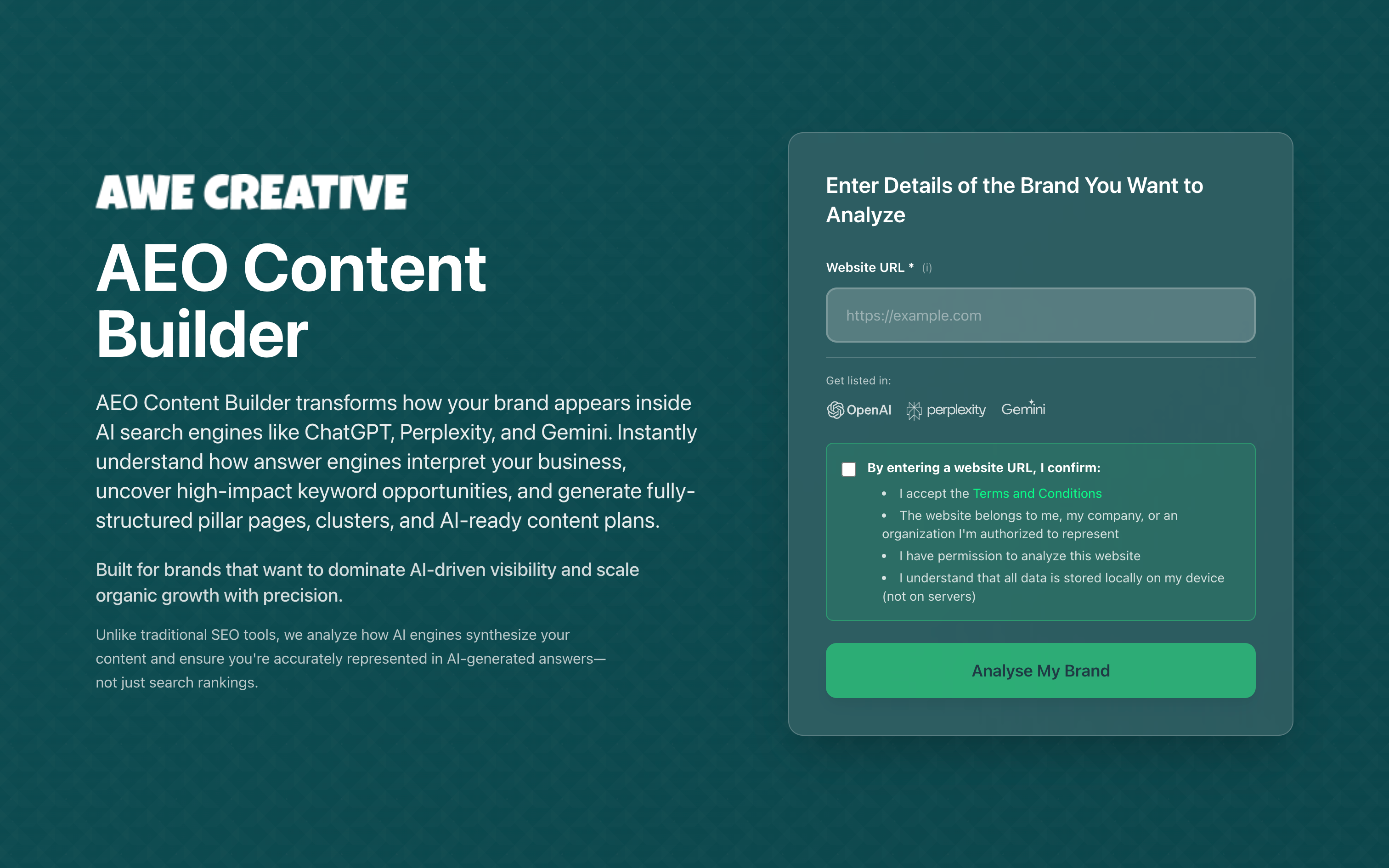
AEO Content Builder
Just enter your website address and we'll do the rest. Instantly understand how AI search engines interpret your business and generate AI-ready content plans.
✓ Enter your website URL
✓ Get instant AI analysis
✓ Receive your content strategy
No credit card required • Instant analysis
How to Implement AI Search & Answer Engine Optimization
Follow this step-by-step framework to implement AEO for your business and start capturing AI-driven traffic.
AI Content Audit & Gap Analysis
2-3 weeksConduct comprehensive audit of existing content against AI search patterns, identify knowledge gaps, and map content to answer-focused queries
Resources Needed:
Answer-Focused Content Strategy
1-2 weeksDevelop content pillars optimized for conversational queries, featured snippets, and direct answer formats that AI engines prioritize
Resources Needed:
Technical AI Readiness Optimization
3-4 weeksImplement structured data markup, optimize page speed for AI crawling, and ensure mobile-first indexing compatibility
Resources Needed:
AI Search Performance Tracking
1 weekSet up monitoring for AI-driven traffic, answer positioning, and conversational query performance metrics
Resources Needed:
Continuous Optimization Cycle
OngoingEstablish ongoing content refinement based on AI search performance data and emerging conversational patterns
Resources Needed:
Track your progress step-by-step with our comprehensive checklist
AI Search Optimization Tools Comparison
Compare the leading tools for optimizing your content for AI search engines and answer engines.
| Tool | Best For | Key Features | Pros | Cons |
|---|---|---|---|---|
MarketMuse | Enterprise content strategy and comprehensive AI optimization |
|
|
|
Clearscope | Mid-market companies focused on content quality and AI readiness |
|
|
|
Frase | Businesses needing AI-assisted content creation and answer optimization |
|
|
|
SEMrush AI Writing Assistant | Existing SEMrush users looking to add AI optimization |
|
|
|
MarketMuse
Best For:
Enterprise content strategy and comprehensive AI optimization
Key Features:
- •AI content planning
- •Competitor gap analysis
- •Topic modeling
- •Content scoring
Pros:
- ✓Advanced AI capabilities
- ✓Comprehensive competitor analysis
- ✓Excellent for B2B content
Cons:
- ✗High cost
- ✗Steep learning curve
- ✗Overkill for small businesses
Clearscope
Best For:
Mid-market companies focused on content quality and AI readiness
Key Features:
- •Content optimization
- •Keyword analysis
- •Readability scoring
- •Competitor content insights
Pros:
- ✓User-friendly interface
- ✓Strong content recommendations
- ✓Good value for money
Cons:
- ✗Limited advanced AI features
- ✗Smaller keyword database
- ✗Basic competitor analysis
Frase
Best For:
Businesses needing AI-assisted content creation and answer optimization
Key Features:
- •AI content creation
- •Answer optimization
- •Content briefs
- •SERP analysis
Pros:
- ✓Excellent for answer-focused content
- ✓AI writing assistance
- ✓Good for local businesses
Cons:
- ✗Content quality varies
- ✗Limited advanced features
- ✗Basic analytics
SEMrush AI Writing Assistant
Best For:
Existing SEMrush users looking to add AI optimization
Key Features:
- •AI content optimization
- •Tone adjustment
- •Readability analysis
- •SEO recommendations
Pros:
- ✓Integrates with existing SEO tools
- ✓Good for quick optimizations
- ✓Affordable add-on
Cons:
- ✗Limited standalone features
- ✗Basic AI capabilities
- ✗Not comprehensive for AI search
Real-World Use Cases
See how different businesses are successfully implementing AI Search & Answer Engine Optimization.
Local Service Provider Dominating AI Answers
The Challenge
Competitors capturing all voice search and AI assistant queries for local services
The Solution
Optimize service pages for conversational queries and local intent, implement structured data for business information
The Results
50% increase in AI-driven leads and 35% higher conversion rates from voice search traffic
B2B Service Provider Breaking Through AI Search Barriers
The Challenge
Traditional SEO not generating qualified leads, competitors dominating AI answer positions
The Solution
Develop comprehensive answer-focused content strategy targeting B2B decision-maker questions
The Results
3x increase in qualified lead volume and 40% reduction in customer acquisition cost
Industry Leader Future-Proofing Search Presence
The Challenge
Organic traffic declining as AI chatbots answer questions directly, losing market share to AI-optimized competitors
The Solution
Implement enterprise AI search optimization with continuous monitoring and rapid adaptation to AI algorithm changes
The Results
Maintained market leadership position with 60% of AI-generated answers featuring their content
Common AI Search Optimization Mistakes to Avoid
Learn from common mistakes to ensure your AI search optimization strategy succeeds.
Treating AI Search Like Traditional SEO
Why This Happens
Assuming keyword density and backlinks work the same way in AI-driven environments
How to Avoid It
Focus on comprehensive answers, conversational queries, and user intent rather than traditional ranking factors
Ignoring Structured Data and Technical Foundations
Why This Happens
Underestimating how much AI engines rely on structured data to understand and feature content
How to Avoid It
Implement comprehensive schema markup, ensure fast loading times, and optimize for mobile-first indexing
Creating Thin, Unhelpful Content for Answers
Why This Happens
Trying to game the system with quick answers rather than providing genuine value
How to Avoid It
Develop comprehensive, authoritative content that thoroughly answers user questions and provides additional context
Not Tracking AI-Specific Performance Metrics
Why This Happens
Relying on traditional analytics that don't capture AI-driven traffic and engagement
How to Avoid It
Implement AI-specific tracking for voice search, featured snippets, and AI assistant interactions
Failing to Update Legacy Content for AI Readability
Why This Happens
Assuming old content that ranks well in traditional search will perform in AI environments
How to Avoid It
Audit and update existing content for conversational tone, direct answers, and AI-friendly formatting
Competitor Gaps in AI Search Optimization
Identify opportunities where competitors are falling short and how you can gain a competitive advantage.
Lack of Answer-Focused Content Strategy
Why Competitors Miss This
Still optimizing for traditional search intent rather than conversational AI queries
Your Advantage
Develop content specifically designed to be featured as direct answers in AI search results
Poor Technical AI Readiness
Why Competitors Miss This
Underinvesting in structured data, page speed, and mobile optimization critical for AI crawling
Your Advantage
Technical foundation optimized specifically for AI engine requirements and crawling patterns
No AI Performance Measurement
Why Competitors Miss This
Relying on traditional analytics that don't capture AI-driven traffic and engagement metrics
Your Advantage
Comprehensive tracking of AI search performance with dedicated optimization cycles
Frequently Asked Questions
What is the difference between SEO and Answer Engine Optimization?
Traditional SEO focuses on ranking websites in search results, while AEO optimizes content to be featured as direct answers in AI-powered search engines. AEO requires structured data, conversational content, and technical precision to capture featured snippets and voice search results, whereas SEO prioritizes backlinks and traditional ranking factors.
How does structured data impact Answer Engine Optimization?
Structured data and schema markup are critical for AEO because they help AI search engines understand content context and relationships. Proper implementation increases the likelihood of your content being featured in direct answers, featured snippets, and voice search results by providing clear semantic meaning to search algorithms.
What content structure works best for answer engines?
Answer engines prefer content structured with clear hierarchies, concise answers at the beginning, and comprehensive coverage following. Use question-based headings, bullet points for key information, and natural language patterns that match how people speak and ask questions verbally.
How do you measure Answer Engine Optimization success?
Track featured snippet appearances, voice search ranking positions, direct answer click-through rates, and engagement metrics for answer-focused content. Use tools that monitor position zero rankings and analyze how often your content appears as direct answers across different AI search platforms.
What are the key technical requirements for AEO?
Essential technical requirements include schema markup implementation, fast loading speeds, mobile optimization, secure HTTPS connections, and clean URL structures. Technical AEO also involves optimizing for voice search compatibility and ensuring content is easily crawlable by AI algorithms.
How does voice search optimization differ from traditional AEO?
Voice search optimization requires even more conversational language, local intent consideration, and immediate answer delivery. While AEO focuses on direct answers generally, voice optimization specifically targets spoken queries with natural language patterns and context-aware responses.
What are the most common AEO implementation mistakes?
Common mistakes include neglecting schema markup, using overly complex language, failing to answer questions directly, ignoring mobile optimization, and not testing across different AI platforms. Many businesses also underestimate the importance of local optimization for voice search queries.
How can businesses create an AEO implementation roadmap?
Start with a content audit to identify answer opportunities, implement technical foundations like schema markup, optimize existing content for direct answers, create new question-focused content, and establish tracking for featured snippets and voice search performance.
What role does natural language processing play in AEO?
Natural language processing (NLP) is fundamental to AEO as AI search engines use NLP to understand user intent and content meaning. Optimizing for NLP involves using conversational language, semantic relationships, and context that matches how humans naturally communicate and ask questions.
How important is local optimization for answer engines?
Local optimization is crucial for AEO, especially for voice search where 'near me' queries dominate. Ensure business information is consistent across directories, implement local schema markup, and optimize for location-based questions to capture local answer engine results.
Glossary
Answer Engine Optimization (AEO)
The practice of optimizing content to be featured as direct answers in AI-powered search engines and voice assistants.
Featured Snippet
A highlighted search result that appears at the top of Google's search results, providing a direct answer to a user's query.
Schema Markup
Structured data vocabulary added to HTML to help search engines understand content context and relationships.
Voice Search Optimization
Optimizing content for spoken queries and voice assistants like Siri, Alexa, and Google Assistant.
Position Zero
The featured snippet position that appears above organic search results, providing direct answers to queries.
Natural Language Processing (NLP)
AI technology that enables computers to understand, interpret, and respond to human language naturally.
Semantic Search
Search technology that focuses on understanding searcher intent and contextual meaning rather than just keyword matching.
Conversational AI
AI systems designed to engage in human-like conversations and provide contextual responses.
Direct Answer
A concise response provided directly by search engines without requiring users to click through to websites.
Knowledge Graph
Google's knowledge base used to enhance search results with semantic search information from various sources.
Structured Data
Standardized format for providing information about a page and classifying page content for search engines.
Entity Optimization
Optimizing content around specific entities (people, places, things) rather than just keywords.
Question Answering
AI capability to understand questions and provide accurate, relevant answers from available information.
Ready to Optimize Your Content for AI Search?
Let's discuss how AEO can transform your lead generation strategy.
Ready to get started?
Get Your AEO Implementation ChecklistTrack your progress step-by-step with our comprehensive checklist