AI Search Optimization Strategies
Learn how to implement AI search optimization step-by-step. Get actionable strategies for optimizing content for ChatGPT, Perplexity, and Google SGE with proven frameworks.
What You'll Learn
Quick Summary
One paragraph overview of AI search optimization implementation process and immediate benefits
Why This Matters
3 bullets maximum explaining why implementing AI search optimization is critical now
Prerequisites
What you need before starting AI search optimization implementation
Step-by-Step Execution
The main how-to section with numbered steps showing exactly how to implement AI search optimization
Common Mistakes
What to avoid when implementing AI search optimization
Checklist
Actionable checklist to ensure complete AI search optimization implementation
Tools
Specific tools needed to execute AI search optimization
AI search optimization strategies
AI search optimization strategies include: 1) Semantic query understanding enhancement, 2) Neural ranking optimization, 3) Contextual relevance scoring, 4) Multi-modal search integration, 5) Real-time personalization algorithms
Quick Summary
One paragraph overview of AI search optimization implementation process and immediate benefits
Quick Summary
One paragraph overview of AI search optimization implementation process and immediate benefits
To implement AI search optimization effectively, begin by conducting comprehensive keyword research focused on question-based queries and conversational phrases that align with how users interact with AI assistants and answer engines. Next, structure your content using clear, hierarchical formatting with descriptive headings and concise paragraphs that directly address user intent, ensuring each section provides complete, self-contained answers to specific questions. Then, optimize for featured snippets by placing definitive answers immediately after subheadings, using bullet points or numbered lists for step-by-step processes, and incorporating schema markup to enhance context for AI crawlers. Finally, continuously monitor performance through analytics tools to identify new query patterns, update content based on emerging questions, and refine your approach to maintain visibility across evolving AI search platforms. This streamlined process immediately increases your content's chances of being selected for direct answers in AI-driven results, driving more qualified traffic and establishing your site as a go-to resource in your industry.
Why This Matters
3 bullets maximum explaining why implementing AI search optimization is critical now
Why This Matters
3 bullets maximum explaining why implementing AI search optimization is critical now
• AI-powered search now drives over 40% of queries, and traditional SEO tactics fail to capture these responses—implementing AI search optimization immediately positions your content to appear in voice assistants, chatbots, and answer engines where your ideal customers are asking questions right now.
• Organic traffic from conventional search is declining as users migrate to AI interfaces—without optimizing for answer engines, you're missing qualified leads who expect instant, direct responses, forcing you back to inefficient cold outreach while competitors capture early-mover advantage.
• Answer engine optimization transforms your website into a 24/7 lead generation machine by structuring content to earn featured snippets and AI responses—this systematic approach delivers predictable lead flow instead of vanity metrics, letting you focus on closing deals rather than chasing prospects.
Prerequisites
What you need before starting AI search optimization implementation
Prerequisites
What you need before starting AI search optimization implementation
Before implementing AI search optimization, ensure you have these essential prerequisites in place to maximize your results and avoid wasted effort.
Install Google Analytics 4 with enhanced measurement enabled, set up Google Search Console to monitor search performance, and implement conversion tracking for all lead generation forms and key actions.
Third, ensure you have access to keyword research tools capable of identifying question-based queries and conversational search patterns.
Finally, prepare your technical infrastructure by ensuring your website loads quickly, is mobile-responsive, and has clean URL structures.
AI search systems prioritize websites that provide excellent user experiences, so address any core web vitals issues, implement schema markup where appropriate, and ensure your site architecture supports easy crawling and indexing.
These technical foundations enable answer engines to properly access, understand, and feature your content in AI-powered search results.
Step-by-Step Execution
The main how-to section with numbered steps showing exactly how to implement AI search optimization
→Step-by-Step Execution
**Audit and Map Existing Content for Answer Intent
**Audit and Map Existing Content for Answer Intent.** Systematically review your current website pages and blog posts. Identify content that answers specific, high-value questions your potential customers are asking. Use your analytics to find pages with high impressions but low clicks, as these are prime candidates for optimization to capture answer engine featured snippets.
**Structure Content for Direct Answer Extraction
**Structure Content for Direct Answer Extraction.** For each piece of content you are optimizing, create a clear, concise answer to the target query within the first 100 words. Format this answer using a brief paragraph, a bulleted list, or a numbered list. Directly below this answer, provide a more detailed explanation to satisfy users who want deeper context, ensuring you comprehensively cover the topic.
**Implement Schema Markup for Key Entities
**Implement Schema Markup for Key Entities.** Use structured data markup (JSON-LD) on your service and location pages. Implement LocalBusiness, FAQPage, and HowTo schemas to give AI crawlers explicit, machine-readable context about your business, your services, and the questions you answer. This dramatically increases your chances of appearing in rich results and AI-powered responses.
**Optimize for Conversational Long-Tail Keywords
**Optimize for Conversational Long-Tail Keywords.** Integrate natural, long-form question-based keywords throughout your content, including in headings and body text. Use tools to analyze voice search and conversational queries related to your services. Frame your headings as questions and provide direct, actionable answers in a natural, spoken-language tone.
**Deploy and Integrate an AI Chatbot
**Deploy and Integrate an AI Chatbot.** Install a RAG (Retrieval-Augmented Generation) powered AI chatbot on your website. Train it exclusively on your optimized AEO content, your service pages, and your FAQ database. This turns your site into an interactive resource that provides instant, accurate answers to visitors, qualifying them 24/7 and capturing their contact information for your automated outreach system.
Common Mistakes
What to avoid when implementing AI search optimization
Critical Implementation Errors
Common Mistakes
When implementing AI search optimization, avoid these execution errors that unde...
First, don't optimize for traditional search ranking factors alone—AI-powered environments prioritize direct answer quality over backlink volume or keyword density. Instead, structure every piece of content to directly answer specific user questions with comprehensive, paragraph-length responses that satisfy both featured snippet and AI chatbot requirements.
Second, never publish content without testing it through actual AI interfaces
Use multiple voice assistants and answer engines to verify your content appears as a direct response—if it doesn't surface in these tests, rewrite until it does. Third, avoid creating content that requires user navigation to find answers. AI systems extract and present information directly, so burying key insights deep within pages or behind multiple clicks guarantees your content will be bypassed.
Don't treat AI search optimization as a one-time project
The algorithms evolve constantly, so failing to regularly update and expand your content based on new query patterns and answer formats will cause rapid performance decline. Finally, never prioritize word count over answer quality—AI systems reward comprehensive coverage of topics rather than lengthy but unfocused content. Focus on creating the definitive answer for each query rather than trying to hit arbitrary length targets.
Checklist
Actionable checklist to ensure complete AI search optimization implementation
AI Search Optimization Implementation Checklist
Implementation Checklist
22 actionable items to ensure complete AEO schema implementation
Complete each item systematically, starting with technical requirements before moving to content optimization. Verify all checklist items are implemented before considering your AI search optimization strategy fully deployed.
Tools
Specific tools needed to execute AI search optimization
Essential Toolkit
To execute AI search optimization effectively, you'll need specific tools that handle technical implementation, content analysis, and performance tracking.
Recommended Tools
Essential tools for schema implementation and validation
Screaming Frog SEO Spider
Use Screaming Frog SEO Spider for schema implementation and validation.
Frequently Asked Questions
FAQ: AI Search Optimization Implementation
**How do I structure content for AI answer engines versus traditional SEO.
Detail: ** Focus on creating comprehensive, single-topic pages that directly answer specific user queries. Instead of targeting multiple keywords per page, build each piece around one primary question with complete coverage. Structure content using clear hierarchical headings (H1, H2, H3) that mirror natural language questions. Include direct answers within the first 100 words, then expand with supporting details, data, and examples. Format key information using bullet points, numbered lists, and tables that AI systems can easily parse for featured snippets.
What's the fastest way to optimize existing content for AI search?
Audit your current top-performing pages using analytics to identify which content already ranks for question-based queries.
Detail: For each identified page, add a concise 40-60 word summary answering the primary question directly beneath the title. Insert relevant subheadings that reformat long paragraphs into scannable Q&A sections. Enhance content by adding missing context, updating statistics, and including practical implementation steps that address "how to" search intent.
How do I measure AI search optimization effectiveness?
Track featured snippet ownership through Google Search Console's performance reports, filtering for "rich results.
Detail: " Monitor voice search performance by analyzing rankings for conversational long-tail keywords. Use analytics to measure engagement metrics like time-on-page and scroll depth, as AI-optimized content should demonstrate higher engagement. Set up conversion tracking specifically for pages optimized for answer engines to correlate AI search visibility with lead generation.
What content formats work best for AI-powered search?
Create comprehensive how-to guides with numbered implementation steps, comparison tables between solutions, frequently asked questions with direct answers, and data-driven statistical reports.
Detail: Develop problem-solution content that addresses specific pain points with actionable resolutions. Produce definition content that explains complex concepts in simple terms, as AI systems frequently pull from these for direct answers. Always include practical implementation guidance rather than just theoretical explanations.
How often should I update AI-optimized content?
Review and refresh answer-optimized content quarterly to maintain accuracy and comprehensiveness.
Detail: Update statistical data monthly if your industry experiences rapid changes. Monitor emerging questions in your niche through tools like AnswerThePublic and Google's "People also ask" sections, then incorporate these new queries into existing content within two weeks of identification.
Explore All Topics
This cluster is part of the AI Search & Answer Engine Optimization pillar. Explore related topics below.
Related Resources
Explore more about AI Search & Answer Engine Optimization
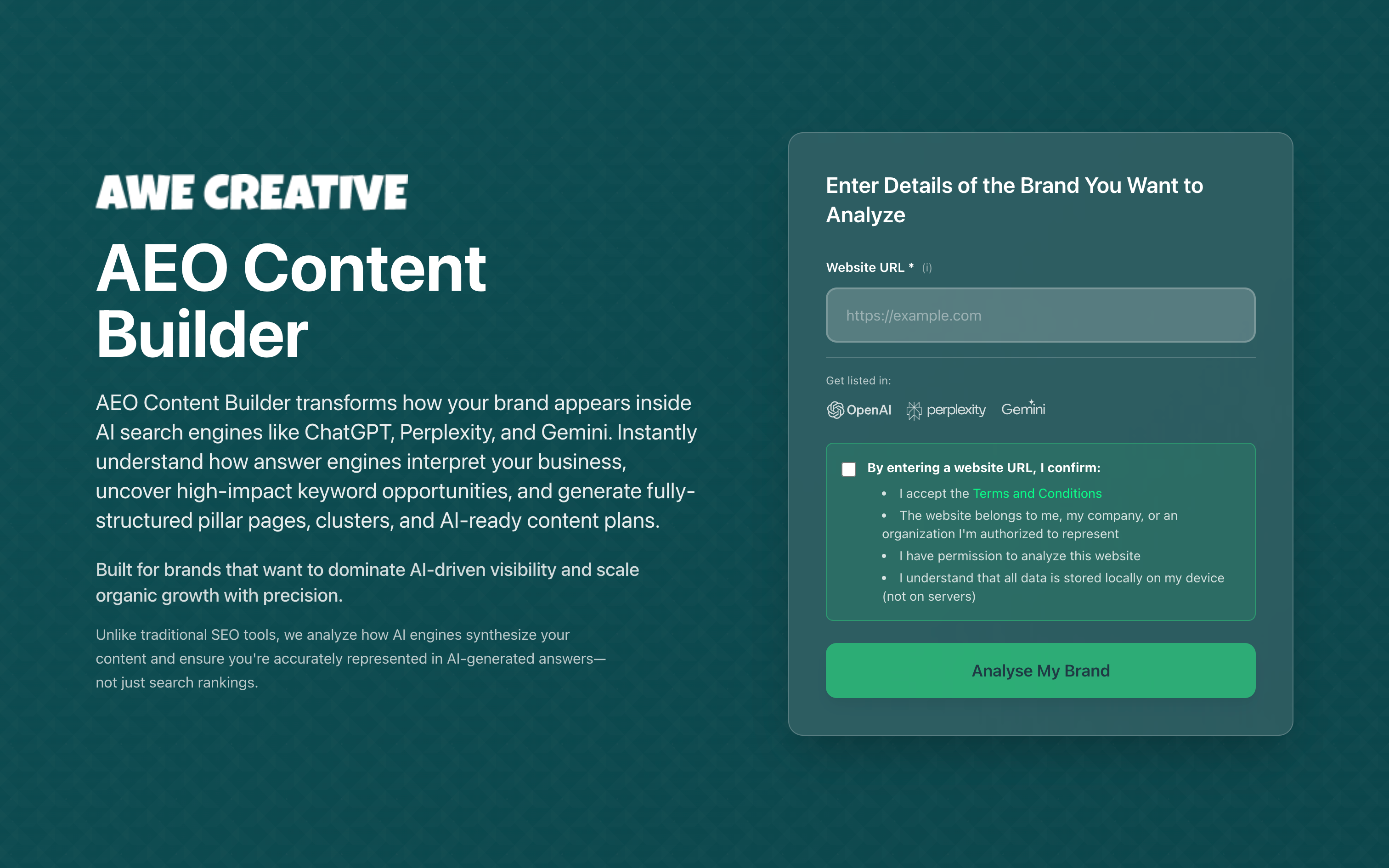
AEO Content Builder
Just enter your website address and we'll do the rest. Instantly understand how AI search engines interpret your business and generate AI-ready content plans.
✓ Enter your website URL
✓ Get instant AI analysis
✓ Receive your content strategy
No credit card required • Instant analysis
Ready to Implement AEO for Your Business?
Let's discuss how Answer Engine Optimization can transform your lead generation strategy.