Answer Engine Optimization Fundamentals
Learn how to implement schema markup for answer engine optimization with our step-by-step guide. Includes JSON-LD examples, validation tools, and testing methods for ChatGPT, Perplexity, and Google SGE.
What You'll Learn
Quick Summary
One paragraph overview of AEO schema implementation process and immediate benefits
Why This Matters
3 bullets maximum explaining why proper schema implementation is critical for AEO success
Prerequisites
Technical requirements and knowledge needed before starting schema implementation
Step-by-Step Execution
7 numbered steps showing exactly how to implement schema markup for AEO
Common Mistakes
Specific implementation errors to avoid when adding schema for answer engines
Checklist
Actionable checklist to ensure complete AEO schema implementation
Tools
Specific tools needed for schema implementation, validation, and testing
what is answer engine optimization
Answer Engine Optimization (AEO) is the practice of optimizing content to appear in AI-powered answer engines and voice search results by providing direct, concise answers to user queries through structured data, natural language processing, and semantic understanding.
Quick Summary
One paragraph overview of AEO schema implementation process and immediate benefits
Quick Summary
One paragraph overview of AEO schema implementation process and immediate benefits
: Implementing schema markup for answer engine optimization transforms your content into machine-readable data that AI search systems directly parse to feature your information in voice answers, chatbots, and featured snippets, immediately increasing visibility without waiting for traditional SEO rankings to build. This process involves identifying key content sections on your pages, selecting appropriate schema types like FAQPage, HowTo, or Article, generating the structured data using tools like Google's Structured Data Markup Helper, validating the code with the Rich Results Test, and deploying it through your CMS or directly in HTML. By executing this correctly, you'll start capturing qualified leads from AI-driven searches within days, turning your website into a 24/7 lead generation engine that answers specific user queries directly in the answer box, bypassing competitors still relying on outdated optimization methods that no longer work in AI-powered search environments.
Why This Matters
3 bullets maximum explaining why proper schema implementation is critical for AEO success
Why This Matters
3 bullets maximum explaining why proper schema implementation is critical for AEO success
Proper schema implementation directly determines whether your content gets featured in AI-powered answer engines or gets buried in traditional search results.
Without structured data markup, you're essentially invisible to the systems that power voice assistants, chatbots, and featured snippets—where your ideal customers are increasingly finding solutions.
This isn't about minor ranking improvements; it's about securing prime digital real estate in the new search landscape.
Prerequisites
Technical requirements and knowledge needed before starting schema implementation
Prerequisites
Technical requirements and knowledge needed before starting schema implementation
Before implementing schema markup for answer engine optimization, ensure you have these technical requirements and foundational knowledge in place.
You'll need administrative access to your website's backend, including content management system permissions or direct server access for code implementation.
Install a text editor like Sublime Text or VS Code for modifying HTML files, and have your Google Search Console account verified and accessible for monitoring results.
Prepare a spreadsheet documenting your key content pages, target queries, and desired answer types to maintain strategic focus during implementation.
Required resources include your website's sitemap, access to server files or CMS templates, and a documented content strategy highlighting which pages target specific answer engine opportunities.
Ensure you have team members assigned to review implementation across different device types and maintain version control of modified files.
Step-by-Step Execution
7 numbered steps showing exactly how to implement schema markup for AEO
Quick Summary
This playbook provides the exact execution sequence for implementing schema markup that positions your content to capture answer engine visibility, turning your website into a lead generation asset for the AI age instead of a source of vanity metrics.
Why This Matters
- •Without structured data, your content is invisible to AI answer engines, causing you to miss the massive shift from traditional search.
- •Proper schema implementation directly addresses the pain of low conversion rates by making your services and contact information instantly accessible to AI assistants.
- •This is the foundational technical step to stop chasing business with cold calls and start having your website sell for you 24/7.
Prerequisites
- ✓Access to your website's HTML or a CMS that allows code editing (e.g., WordPress with a plugin like Rank Math or Schema Pro).
- ✓A Google Search Console account for validation and monitoring.
- ✓Your target service pages and contact page finalized and published.
→Step-by-Step Execution
Identify Your Core Answerable Questions: Review your target service pages
Identify Your Core Answerable Questions: Review your target service pages. For each page, write down the 2-3 most critical questions a potential lead would ask, such as "What is [Your Service]?" or "How much does [Your Service] cost?". These questions dictate which schema types you need.
Select and Generate the Schema Markup: Use a tool like Googl...
Select and Generate the Schema Markup: Use a tool like Google’s Structured Data Markup Helper. Select the appropriate data type (e.g., "Service" for a service page, "FAQPage" for a Q&A section, "LocalBusiness" for your contact page). Highlight the relevant text on your live webpage within the tool and tag it accordingly (e.g., tag your service description, price, and area served).
Download and Inject the JSON-LD Code: Once tagged, download ...
Download and Inject the JSON-LD Code: Once tagged, download the generated JSON-LD code from the markup helper. Copy this code block and paste it directly into the `<head>` section of the corresponding webpage's HTML, just before the closing `</head>` tag.
Implement LocalBusiness Schema on Your Contact Page: This is...
Implement LocalBusiness Schema on Your Contact Page: This is non-negotiable for lead generation. Ensure your contact page includes a comprehensive LocalBusiness schema with your company name, address, phone number, service areas, and price range. This allows voice assistants to directly answer "Call [Your Business]" for nearby users.
Validate Your Markup Immediately: Use Google’s Rich Results Test tool
Validate Your Markup Immediately: Use Google’s Rich Results Test tool. Paste your webpage URL or the copied code snippet into the tester. Scrutinize the report for any errors or warnings and return to your HTML to fix them before proceeding.
Deploy and Monitor in Google Search Console: Once validated,...
Deploy and Monitor in Google Search Console: Once validated, your schema is live. Go to Google Search Console, select your property, and use the "URL Inspection" tool to fetch and submit the updated pages. Monitor the "Enhancements" report in Search Console over the following weeks for performance data and to ensure no errors emerge.
Test with AI Chatbots: Conduct real-world tests
Test with AI Chatbots: Conduct real-world tests. Pose the questions from Step 1 to chatbots like ChatGPT, Google Bard, or Perplexity. See if the AI retrieves and cites information directly from your newly marked-up pages. If not, refine your schema and content to be more direct and question-focused.
Common Mistakes
Specific implementation errors to avoid when adding schema for answer engines
Critical Implementation Errors
Don't let sloppy schema implementation sabotage your answer engine optimization efforts and leave you with a beautiful website that generates zero leads. These execution errors directly prevent your content from appearing in AI-powered search results, keeping you invisible to qualified prospects while competitors capture market share. Avoid these critical mistakes to ensure your schema markup actually drives visibility and conversions.
Never use generic schema types like "Thing" or "CreativeWork" when specific types exist
For service businesses, immediately implement "LocalBusiness" with complete NAP (Name, Address, Phone) data, plus "Service" schema detailing your specific offerings. Always match your schema markup exactly to your page content—search engines detect and penalize discrepancies between your markup and visible text. When marking up FAQ content, ensure every question in your schema appears verbatim on the page, and every answer matches precisely what users see.
Stop treating schema as a one-time implementation
Regularly audit and update your markup whenever you change services, pricing, or contact information. Abandoned schema creates broken experiences that damage credibility with both users and search engines. Never duplicate schema across pages—each page requires unique markup specific to its content. For service pages, implement "Service" schema with detailed descriptions, while landing pages need "Organization" or "LocalBusiness" markup. Always validate your implementation using Google's Rich Results Test before going live, and monitor for errors monthly. Remember that incomplete schema is worse than no schema—partial implementations signal low-quality content to answer engines, ensuring your competitors' complete markup will rank above yours every time.
Checklist
Actionable checklist to ensure complete AEO schema implementation
Before implementing any schema markup, complete this comprehensive checklist to ensure your answer engine optimization delivers maximum visibility and lead generation results. Tick each item as you execute to guarantee no critical element gets overlooked in your implementation.
Implementation Checklist
15 actionable items to ensure complete AEO schema implementation
Complete every item on this checklist to transform your website from a static brochure into an answer engine-optimized lead generation machine that captures market share while competitors struggle with outdated optimization approaches.
Tools
Specific tools needed for schema implementation, validation, and testing
Essential Toolkit
Quick Summary: This section provides the essential toolkit for implementing, validating, and testing schema markup, ensuring your structured data is technically correct and primed for answer engine visibility.
Recommended Tools
Essential tools for schema implementation and validation
Schema.org
3. **Deploy to Your Website:** Insert the generated JSON-LD code into the `<head>` section of your target webpage, either manually, via a plugin, or ...
Google's Rich Results Test
Use Google's Rich Results Test for schema implementation and validation.
Frequently Asked Questions
FAQ: Schema Implementation for Answer Engine Optimization
**How do I identify which schema types to implement for maximum AEO impact.
Detail: ** Start by analyzing the top 10 search queries driving qualified traffic to your competitors' sites. Use Google's People Also Ask and Related Searches to identify question patterns your schema must address. Focus on FAQPage, HowTo, and Article schemas first since answer engines prioritize these for direct responses. Implement schema that matches both your services (LocalBusiness for service providers) and your content format (HowTo for process explanations).
What's the fastest way to implement schema without technical expertise?
Use Google Tag Manager's custom HTML feature to inject JSON-LD schema directly into your page headers.
Detail: Create templates for your most-used schema types (FAQPage for service questions, Product for offerings) and modify the structured data variables for each page. Validate using Google's Rich Results Test immediately after implementation to catch errors before they impact performance.
How do I test if my schema is actually working for answer engines?
Monitor your Google Search Console performance report specifically for "Rich Results" impressions and clicks.
Detail: Set up tracking for "PAA" (People Also Ask) appearances in your rank tracking software. Use schema validation tools weekly to ensure markup remains error-free after site updates. Check voice search results by asking Alexa or Google Assistant questions your schema should answer.
What schema mistakes immediately hurt AEO performance?
Incomplete markup that leaves required fields empty causes instant rejection by answer engines.
Detail: Avoid marking up hidden content that users can't see - this triggers manual penalties. Never implement schema on low-quality pages just to have markup present. Don't mix schema formats (JSON-LD with Microdata) on the same page, as this creates parsing conflicts for AI systems.
How often should I update my schema markup?
Review and refresh schema quarterly based on new People Also Ask data and changing search patterns.
Detail: Update immediately when you add new services, change pricing, or publish substantial new content. Implement event-based schema for webinars or promotions 48 hours before they go live to ensure answer engines index them properly.
Can I automate schema implementation across my entire site?
Yes - use WordPress plugins like Schema Pro or Rank Math for automatic schema generation based on page type.
Detail: For custom sites, create schema templates in your CMS that populate dynamically from your page elements. Set up automated monthly audits using Screaming Frog's custom extraction features to flag pages missing proper markup.
Explore All Topics
This cluster is part of the AI Search & Answer Engine Optimization pillar. Explore related topics below.
Related Resources
Explore more about AI Search & Answer Engine Optimization
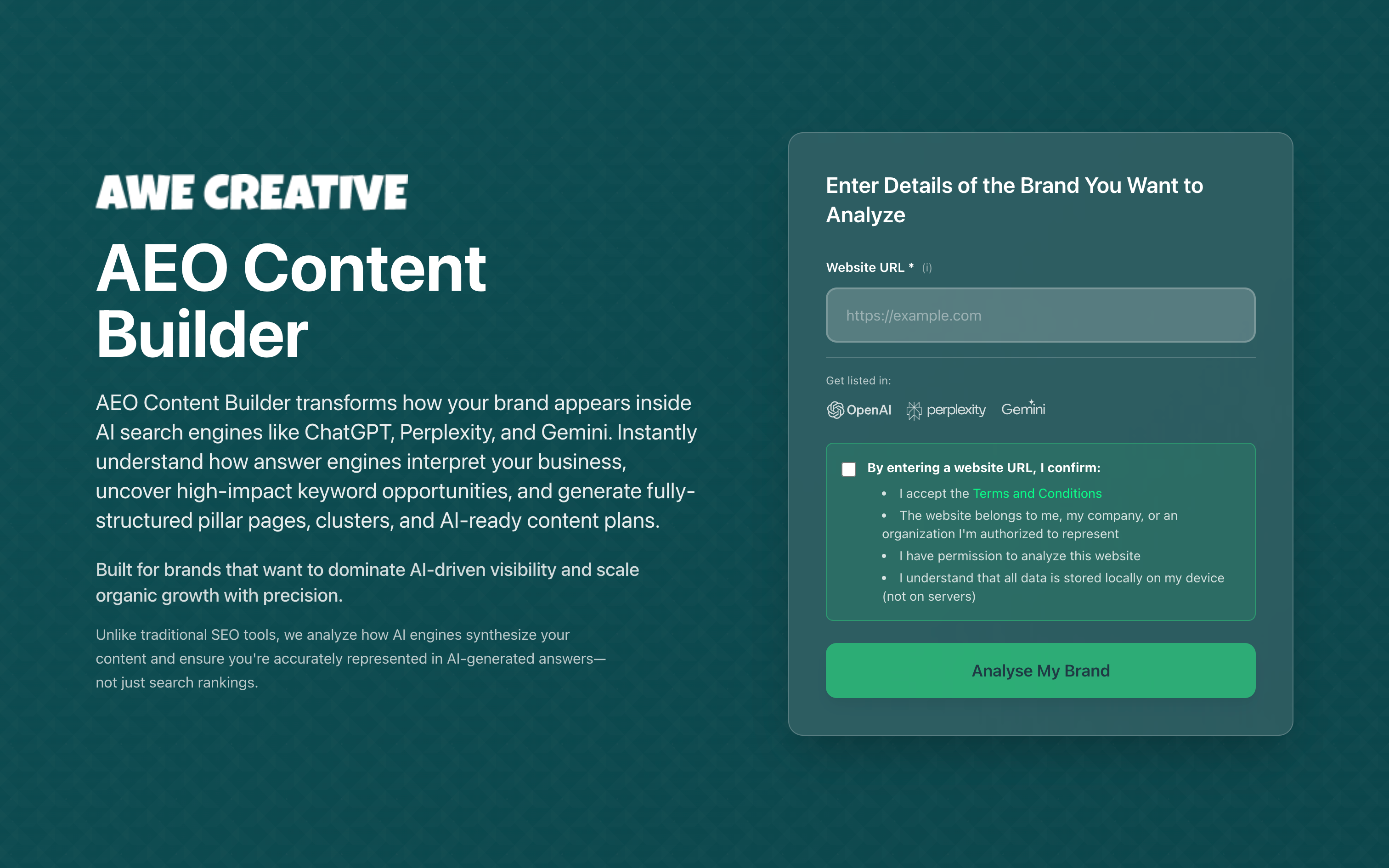
AEO Content Builder
Just enter your website address and we'll do the rest. Instantly understand how AI search engines interpret your business and generate AI-ready content plans.
✓ Enter your website URL
✓ Get instant AI analysis
✓ Receive your content strategy
No credit card required • Instant analysis
Ready to Implement AEO for Your Business?
Let's discuss how Answer Engine Optimization can transform your lead generation strategy.