Content Structure for Answer Engines
Learn step-by-step how to implement schema markup for answer engine optimization. Get JSON-LD templates, validation tools, and testing protocols for ChatGPT, Perplexity, and Google SGE.
What You'll Learn
Quick Summary
One paragraph overview showing how to implement schema markup specifically for answer engine optimization
Why This Matters
3 bullets maximum explaining why schema implementation is critical for AEO success
Prerequisites
Technical requirements and knowledge needed before implementing schema for AEO
Step-by-Step Execution
7 numbered steps showing exactly how to implement schema markup for AEO
Common Mistakes
Specific schema implementation errors that hurt AEO performance
Checklist
Actionable checklist to ensure complete schema implementation for AEO
Tools
Specific tools needed for schema implementation, validation, and testing
content structure for answer engines
Answer engine content structure requires: 1) Semantic chunking, 2) Schema markup implementation, 3) Question-answer formatting, 4) Entity relationship mapping, 5) Contextual relevance signals
Quick Summary
One paragraph overview showing how to implement schema markup specifically for answer engine optimization
Quick Summary
One paragraph overview showing how to implement schema markup specifically for answer engine optimization
Implementing schema markup for answer engine optimization requires a structured approach focused on accuracy, relevance, and machine-readability. Start by identifying the most relevant schema types for your content, such as FAQPage, HowTo, or Article, and use JSON-LD format embedded in your page's head section. Validate your markup using Google's Rich Results Test to ensure it meets answer engine requirements, then deploy and monitor performance through tools like Google Search Console to track impressions and featured snippet placements. This process enhances visibility in AI-powered search environments by providing clear, structured data that answer engines can easily parse and display as direct responses.
Why This Matters
3 bullets maximum explaining why schema implementation is critical for AEO success
Why This Matters
3 bullets maximum explaining why schema implementation is critical for AEO success
Implementing structured data markup is not just another technical SEO task—it's the foundation for capturing visibility in AI-powered search environments.
Without proper schema implementation, your content remains invisible to answer engines like ChatGPT, Perplexity, and Google SGE, which rely on structured data to understand and feature your information in direct responses.
This directly addresses the core pain point of missed opportunities in emerging search platforms where your competitors are already gaining traction.
Prerequisites
Technical requirements and knowledge needed before implementing schema for AEO
Prerequisites
Technical requirements and knowledge needed before implementing schema for AEO
Before implementing schema markup for answer engine optimization, ensure you have these technical prerequisites in place.
First, confirm you have administrative access to your website's backend, including content management system permissions and server file access for direct code implementation.
You'll need working knowledge of JSON-LD syntax and basic HTML structure to correctly place schema markup in page headers or body sections.
Install essential browser tools like the Schema Markup Validator extension and Google's Rich Results Test to validate your implementation.
Prepare your content inventory by identifying key pages targeting featured snippets and answer engine visibility, particularly those with clear Q&A formats, step-by-step instructions, or definitive data points.
Have your organization's structured business information ready, including official name, logo, contact details, and physical address if applicable.
Step-by-Step Execution
7 numbered steps showing exactly how to implement schema markup for AEO
Quick Summary
This playbook provides a systematic approach to implementing schema markup specifically for answer engine optimization, enabling your content to appear in AI-powered search interfaces like ChatGPT, Perplexity, and Google SGE by structuring data for direct answer extraction.
Why This Matters
- •- Schema markup is the primary method AI search engines use to understand and feature your content
- •- Proper implementation increases visibility in next-generation search interfaces
- •- Structured data directly impacts whether your content gets selected for AI-generated answers
Prerequisites
- ✓- Access to your website's HTML or CMS with schema editing capabilities
- ✓- Basic understanding of JSON-LD syntax
- ✓- Google's Structured Data Testing Tool or Schema Markup Validator
- ✓- Clear identification of your target answer types and featured snippet opportunities
→Step-by-Step Execution
Identify the specific answer types your content provides by ...
Identify the specific answer types your content provides by analyzing competitor featured snippets and common user questions in your niche. Focus on FAQ, How-to, Article, and Local Business schema types that align with AI search intent.
Generate precise JSON-LD markup using Schema
Generate precise JSON-LD markup using Schema.org vocabulary that matches your identified answer types. Structure each schema object with complete properties - for FAQ schema, include every question and answer pair; for How-to, detail each step with clear instructions.
Implement the markup directly in your page's HTML head secti...
Implement the markup directly in your page's HTML head section or through your CMS schema plugins. Place JSON-LD scripts immediately after the opening head tag to ensure early parsing by AI crawlers.
Validate your implementation using Google's Rich Results Tes...
Validate your implementation using Google's Rich Results Test, checking for errors and warnings. Test multiple URL variations to ensure consistent markup application across your site.
Deploy schema markup across all relevant pages simultaneousl...
Deploy schema markup across all relevant pages simultaneously rather than gradual implementation. This creates immediate critical mass for AI crawlers to recognize your site as a structured data authority.
Monitor performance through Google Search Console's Enhancem...
Monitor performance through Google Search Console's Enhancements reports, tracking impressions and positions for your structured data. Set up alerts for schema errors or drops in rich result visibility.
Update schema markup monthly based on performance data and e...
Update schema markup monthly based on performance data and emerging AI search patterns. Expand markup to cover new content types and refresh existing schema with current information to maintain AI relevance.
Common Mistakes
Specific schema implementation errors that hurt AEO performance
Critical Implementation Errors
Common Mistakes
Avoid these critical schema implementation errors that directly undermine your a...
.
Using generic schema types instead of specific, relevant markup remains one of t...
Answer engines prioritize precise schema matching the exact content type and user intent. Implement FAQ schema only for genuine question-and-answer content, Product schema with complete specifications for e-commerce pages, and HowTo schema exclusively for procedural content. Never default to generic WebPage or Article schema when more specific types apply, as this fails to provide the structured data answer engines require for direct responses.
Incomplete property implementation consistently hurts AEO performance
When implementing Organization or LocalBusiness schema, include all available properties - especially name, address, telephone, geo coordinates, opening hours, and service areas. For product schema, ensure you include price, availability, review ratings, and SKU data. Partial implementation provides insufficient context for answer engines to understand and feature your content in response to user queries.
Schema markup that contradicts visible content creates immediate trust issues with AI systems
Never include schema properties that don't match what users see on the page. If your schema claims a 5-star rating but the page shows 3 stars, or if business hours in markup differ from those displayed to visitors, answer engines will detect these discrepancies and deprioritize your content. Ensure every schema property accurately reflects the published content.
Technical implementation errors frequently sabotage AEO efforts
Avoid placing schema in unreachable locations where crawlers cannot execute JavaScript. Never implement conflicting schema types on the same page or duplicate the same markup multiple times. Validate all schema using Google's Rich Results Test and Schema Markup Validator before deployment, and regularly audit existing implementations to catch markup that becomes outdated as content changes.
Checklist
Actionable checklist to ensure complete schema implementation for AEO
Complete this checklist to ensure your schema markup implementation drives maximum visibility in AI-powered search environments like ChatGPT, Perplexity, and Google SGE.
Implementation Checklist
10 actionable items to ensure complete AEO schema implementation
After deployment, regularly check Search Console for markup errors and address any validation issues within 48 hours. Monitor your visibility in answer engines by tracking specific long-tail queries where your content should appear as direct answers. Update your schema whenever you publish new content types or refresh existing pages to maintain optimal answer engine performance.
Tools
Specific tools needed for schema implementation, validation, and testing
Essential Toolkit
To implement schema markup effectively for answer engine optimization, you need a specific toolkit that enables precise implementation, validation, and testing.
Recommended Tools
Essential tools for schema implementation and validation
Schema.org
e visually. For more complex implementations, use Schema.org’s full vocabulary directly within your HTML or JSON-LD scripts. Validate every piece of m...
Schema App validator
Use Schema App validator for schema implementation and validation.
Screaming Frog SEO Spider
Use Screaming Frog SEO Spider for schema implementation and validation.
Frequently Asked Questions
FAQ: Schema Implementation for Answer Engine Optimization
**How do I choose which schema types to prioritize for answer engine optimization.
Detail: ** Start by analyzing the most common questions your target audience asks about your services. For B2B service providers, focus on FAQPage, HowTo, and LocalBusiness schemas. Implement FAQ schema on service pages where you answer common client questions, HowTo schema for demonstrating your process, and LocalBusiness schema if you serve specific geographic areas. Use Google's People Also Ask and your own customer service data to identify question patterns.
What's the fastest way to implement schema markup across multiple pages?
Use JSON-LD injected through Google Tag Manager for rapid deployment across your site.
Detail: Create templates for each schema type (FAQ, HowTo, Article) and modify the variables for each page. For dynamic content, implement schema through your CMS templates or use a schema plugin that automatically generates markup based on your content structure. Validate each implementation using Google's Rich Results Test before going live.
How do I validate that my schema is working correctly for AI search engines?
Test your markup using Google's Rich Results Test first to ensure technical correctness.
Detail: Then monitor your performance in Google Search Console's Enhancement reports to track impressions and clicks from rich results. For AI-specific validation, manually test your content in ChatGPT and Perplexity by asking questions your schema markup addresses. Track which queries trigger your content as direct answers and optimize accordingly.
What's the most common technical error in schema implementation that hurts AEO performance?
Incorrect nesting of schema properties causes the most issues.
Detail: Ensure your markup follows the exact hierarchy specified in Schema. org documentation. For example, when implementing FAQ schema, each question must be properly nested within the mainEntity property with both name and acceptedAnswer fields completed. Avoid using conflicting schema types on the same page and ensure all required properties are populated with accurate, current information.
How often should I update my schema markup for optimal AEO performance?
Review and update your schema markup quarterly, or whenever you make significant content changes.
Detail: AI search engines prioritize fresh, accurate information, so regularly refresh your FAQ content with new questions, update your LocalBusiness schema with current operating hours, and expand your HowTo schemas as you develop new service processes. Monitor search performance data to identify which schema types drive the most visibility and double down on those formats.
Explore All Topics
This cluster is part of the AI Search & Answer Engine Optimization pillar. Explore related topics below.
Related Resources
Explore more about AI Search & Answer Engine Optimization
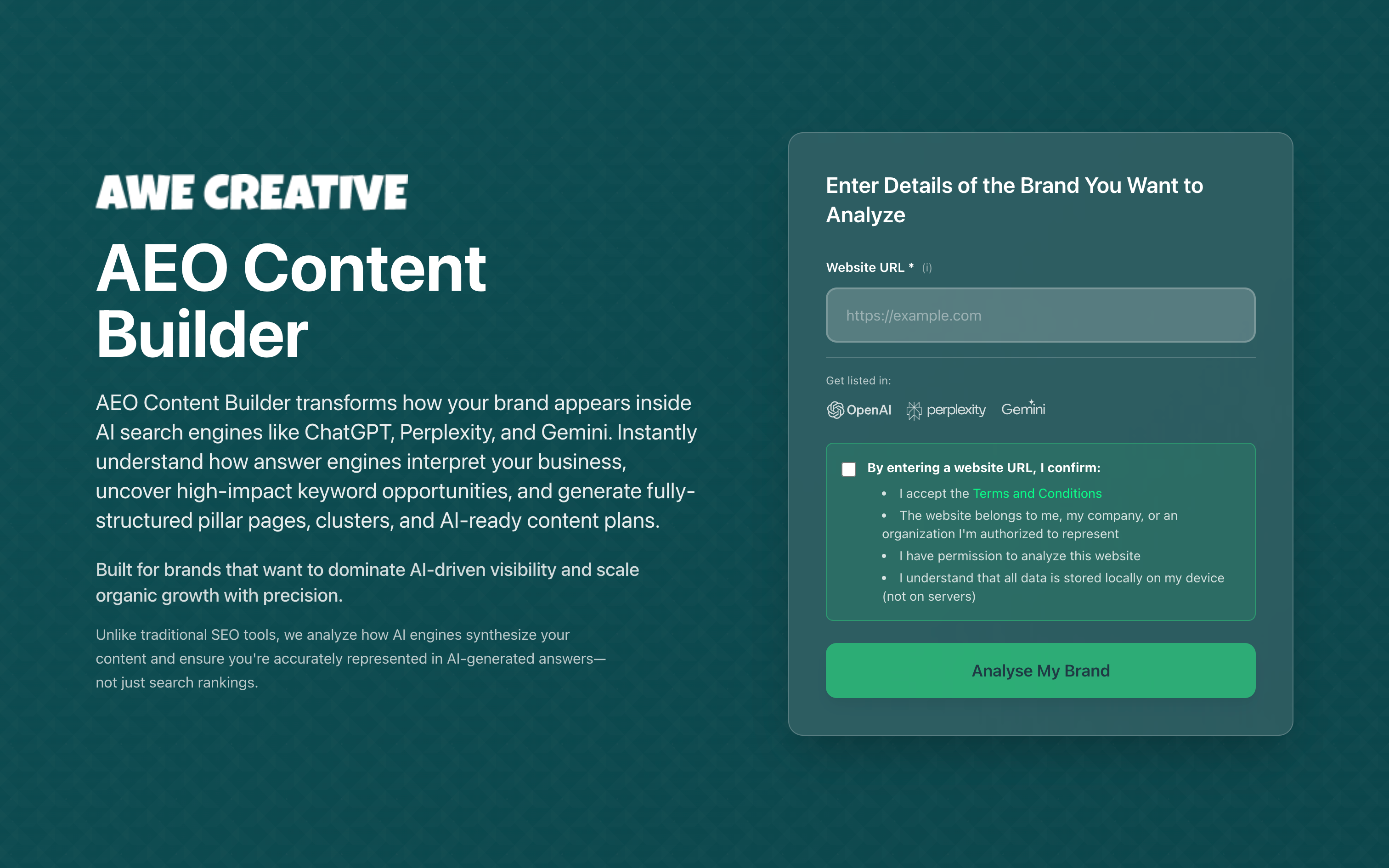
AEO Content Builder
Just enter your website address and we'll do the rest. Instantly understand how AI search engines interpret your business and generate AI-ready content plans.
✓ Enter your website URL
✓ Get instant AI analysis
✓ Receive your content strategy
No credit card required • Instant analysis
Ready to Implement AEO for Your Business?
Let's discuss how Answer Engine Optimization can transform your lead generation strategy.