Technical Implementation
Learn step-by-step schema implementation for answer engine optimization. Create JSON-LD markup, validate with Rich Results Test, and test in ChatGPT/Perplexity/SGE.
What You'll Learn
Quick Summary
One paragraph overview of schema implementation for AEO with immediate value proposition
Why This Matters
3 bullets explaining why schema is critical for answer engine visibility
Prerequisites
Technical requirements and knowledge needed before starting implementation
Step-by-Step Execution
7 numbered steps showing exactly how to implement schema for AEO
Common Mistakes
Technical errors to avoid during schema implementation
Checklist
Actionable implementation checklist to ensure completion
Tools
Specific tools needed for schema implementation and testing
how to implement AI search optimization
5-step technical implementation: 1) API integration setup, 2) Schema markup implementation, 3) Query processing configuration, 4) Performance optimization, 5) Testing and validation
Quick Summary
One paragraph overview of schema implementation for AEO with immediate value proposition
Quick Summary
One paragraph overview of schema implementation for AEO with immediate value proposition
Implementing structured data for answer engine optimization transforms your content into machine-readable formats that AI search systems directly parse, enabling immediate visibility in featured snippets and answer engines. This technical playbook provides a systematic approach to schema markup implementation, focusing on JSON-LD deployment, property selection, and validation testing. By executing these steps, you'll structure your content to match AI search query patterns, increasing the probability of capturing answer engine real estate and driving qualified traffic. The process involves identifying target entities, implementing relevant schema types, testing markup accuracy, and monitoring performance through search console data—creating a foundation for sustainable organic visibility in AI-driven search environments.
Why This Matters
3 bullets explaining why schema is critical for answer engine visibility
Why This Matters
3 bullets explaining why schema is critical for answer engine visibility
Implementing structured data markup directly enables your content to appear in AI-powered answer engines and featured snippets, transforming your website from a passive information source into an active participant in conversational search.
Without precise schema implementation, your content remains invisible to AI search algorithms that rely on explicit data signals to understand and feature responses.
Proper execution bridges the gap between your valuable content and the answer engines that increasingly dominate user queries, ensuring your solutions are presented as direct answers rather than buried in traditional search results.
Prerequisites
Technical requirements and knowledge needed before starting implementation
Prerequisites
Technical requirements and knowledge needed before starting implementation
Before implementing structured data for answer engine optimization, ensure you have these technical prerequisites in place.
First, establish administrative access to your website's backend systems, including content management system credentials, server access, and database permissions where necessary.
You'll need the ability to modify HTML markup and implement code changes across relevant pages.
Second, verify you have comprehensive technical documentation for your existing website infrastructure, including current schema implementations, content types, and page templates.
Third, prepare your testing environment with structured data validation tools already configured.
Install browser extensions like Schema Markup Validator and have Google's Rich Results Test bookmarked for immediate validation.
Step-by-Step Execution
7 numbered steps showing exactly how to implement schema for AEO
Quick Summary
This playbook provides a precise technical implementation sequence for adding structured data markup to your website, enabling direct visibility in AI-powered answer engines and featured snippets.
Why This Matters
- •- Structured data is mandatory for answer engine inclusion
- •- Directly impacts AI search visibility and click-through rates
- •- Enables rich results and voice assistant compatibility
Prerequisites
- ✓- Access to website source code or CMS with schema capability
- ✓- Google's Structured Data Testing Tool
- ✓- Basic understanding of JSON-LD syntax
- ✓- Content already optimized for target queries
→Step-by-Step Execution
Identify target content types requiring schema markup
Identify target content types requiring schema markup. Focus initially on high-priority pages like service descriptions, FAQ sections, product pages, and contact information that align with your primary conversion goals.
Select appropriate schema
Select appropriate schema.org vocabulary types matching your content. For service businesses, implement Service, LocalBusiness, FAQPage, and Organization schemas as foundational elements.
Generate JSON-LD markup using schema generators or hand-code for precision
Generate JSON-LD markup using schema generators or hand-code for precision. Place the script tag within the head section of your HTML or use Google Tag Manager for non-invasive implementation.
Populate all required properties for each schema type
Populate all required properties for each schema type. Include essential fields like name, description, serviceType, areaServed, and contact points. Add optional but valuable properties like priceRange, serviceAudience, and hoursAvailable.
Validate markup using Google's Rich Results Test
Validate markup using Google's Rich Results Test. Check for errors, warnings, and missing recommended properties. Test multiple pages to ensure consistency across your implementation.
Deploy validated schema to your production environment
Deploy validated schema to your production environment. Implement across all relevant pages systematically, prioritizing high-traffic and conversion-focused content first.
Monitor performance through Google Search Console's Enhancement reports
Monitor performance through Google Search Console's Enhancement reports. Track rich result impressions, clicks, and errors. Refine implementation based on performance data and new schema opportunities.
Common Mistakes
Technical errors to avoid during schema implementation
Critical Implementation Errors
Common Mistakes
Avoid these technical errors during schema implementation to prevent answer engi...
.
Using incorrect or mismatched schema types remains the most frequent implementation error
Always verify that your chosen schema type precisely matches your content's purpose—for example, implementing FAQPage schema on a product description page will confuse answer engines and cause rejection. Cross-reference your content against Schema.org's official documentation to select the exact type that represents your content's primary function.
Implementing incomplete required properties consistently undermines schema effectiveness
Each schema type has mandatory properties that must be present for validation. For FAQPage schema, this includes both the mainEntity property and nested acceptedAnswer/text properties. Missing any required element will cause search engines to ignore your structured data entirely. Use the Schema Markup Validator to confirm all required properties are implemented before deployment.
Placing schema markup on irrelevant or low-quality pages wastes implementation e...
Focus schema implementation exclusively on pages containing substantive, answer-focused content that directly addresses user queries. Avoid applying structured data to thin content pages, contact forms, or legal disclaimers where it provides no value to answer engines seeking direct responses.
Over-optimizing with excessive or repetitive markup triggers search engine penal...
Never stuff multiple schema types on a single page or repeat the same information across different markup formats. Implement only the most relevant schema type for each page's primary content, maintaining clean, focused structured data that accurately represents your content without manipulation attempts.
Failing to maintain schema after initial implementation creates technical debt t...
Regularly audit your structured data whenever content changes occur, using monitoring tools to detect validation errors from content updates, page modifications, or schema requirement changes. Implement automated testing within your development workflow to catch schema issues before they impact answer engine visibility.
Checklist
Actionable implementation checklist to ensure completion
Implementation Checklist for Schema Markup Deployment
Implementation Checklist
19 actionable items to ensure complete AEO schema implementation
Complete each item systematically to ensure your structured data implementation delivers maximum answer engine visibility and drives qualified lead generation through AI search channels.
Tools
Specific tools needed for schema implementation and testing
Essential Toolkit
To implement schema markup effectively for answer engine optimization, you'll need specialized tools for generation, validation, and testing.
Recommended Tools
Essential tools for schema implementation and validation
Google's Structured Data Markup Helper
Use Google's Structured Data Markup Helper for schema implementation and validation.
Schema.org
uirements for featured snippets and answer boxes. Schema.org provides the complete vocabulary reference for all available properties and types. For o...
Merkle's Schema Markup Generator
Use Merkle's Schema Markup Generator for schema implementation and validation.
Frequently Asked Questions
FAQ: Schema Implementation for Answer Engine Optimization
**How do I validate schema markup before deployment.
Detail: ** Use Google's Rich Results Test tool to validate your structured data. Copy your HTML source code or enter your live URL, then review any errors or warnings. For bulk validation across multiple pages, use the Schema Markup Validator. Test both individual pages and your entire site structure to ensure consistency. Fix all critical errors before deployment, but also address warnings that could impact how answer engines interpret your content.
What's the most efficient way to implement schema across multiple pages?
Automate schema generation through your CMS templates or using JSON-LD injection scripts.
Detail: For WordPress sites, use plugins like Schema Pro or Rank Math that automatically apply appropriate schema types to different content templates. For custom builds, create reusable schema templates in your development framework that populate dynamically with page-specific content. This ensures consistent implementation while minimizing manual coding for each page.
How frequently should I update existing schema markup?
Review and update schema quarterly, or whenever you make significant content changes to your pages.
Detail: Monitor Google Search Console's Enhancement reports for schema errors and deprecated features. When Google announces updates to structured data guidelines (typically 2-3 times annually), audit your implementation within 30 days to maintain answer engine visibility. Set calendar reminders for these routine audits to prevent gradual degradation.
What schema types deliver the best results for B2B service providers?
Prioritize Service, LocalBusiness, FAQPage, HowTo, and Organization schema types.
Detail: Service schema should include your service areas, pricing information, and service descriptions. LocalBusiness must contain your NAP (name, address, phone) details with proper formatting. FAQ schema captures question-and-answer content that frequently appears in answer engine results. Implement Organization schema on your homepage to establish entity authority across all your digital properties.
How do I troubleshoot schema that isn't generating answer engine appearances?
First, verify your markup passes all validation checks.
Detail: Then, use Google Search Console's Performance report to see if your pages are appearing for relevant queries but not generating rich results. Check that your schema matches the actual visible content on the page - discrepancies can cause rejection. Ensure you're using the most current schema. org vocabulary, as deprecated properties won't parse correctly. If issues persist, test with simplified markup first, then gradually add complexity while monitoring results.
Explore All Topics
This cluster is part of the AI Search & Answer Engine Optimization pillar. Explore related topics below.
Related Resources
Explore more about AI Search & Answer Engine Optimization
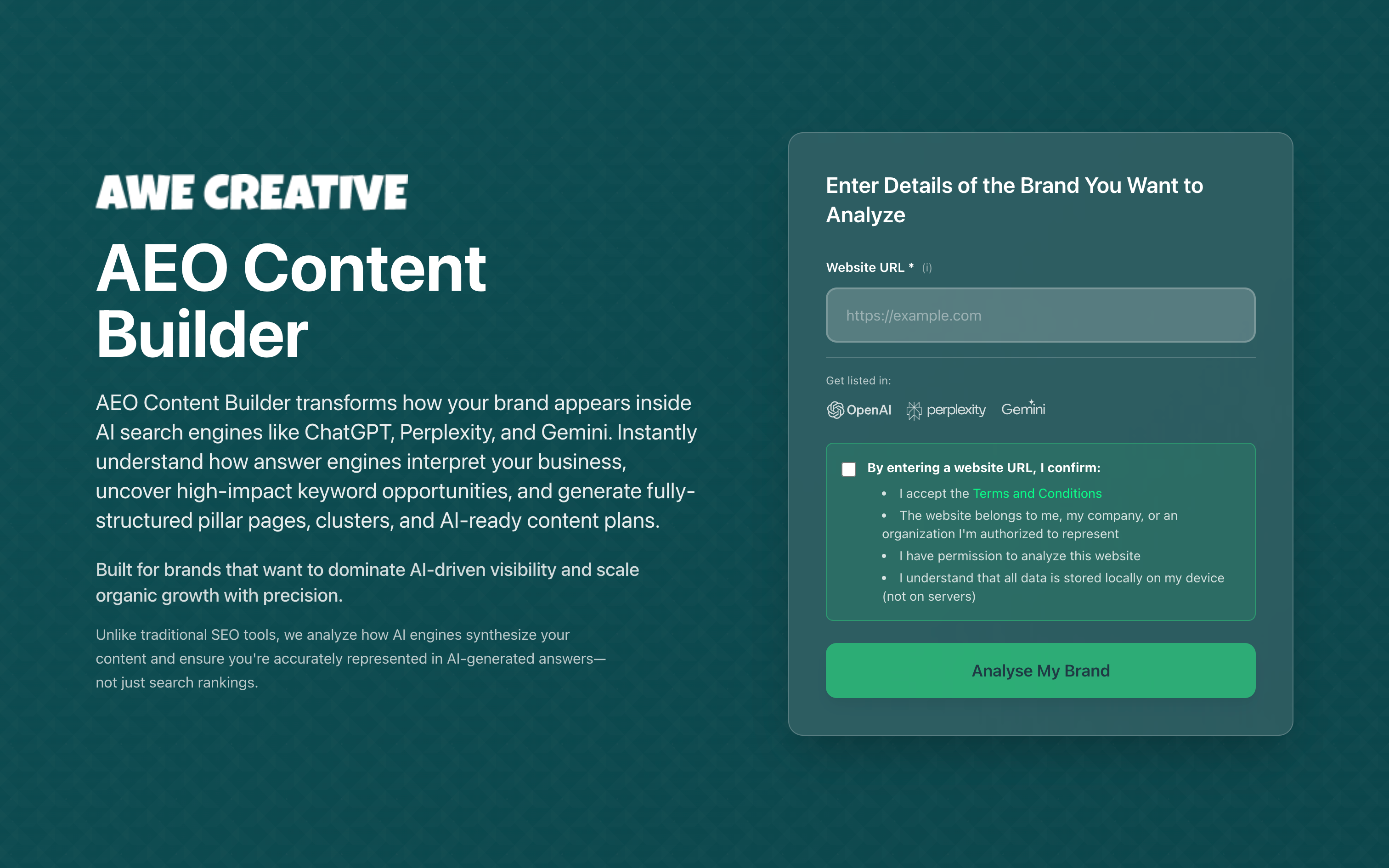
AEO Content Builder
Just enter your website address and we'll do the rest. Instantly understand how AI search engines interpret your business and generate AI-ready content plans.
✓ Enter your website URL
✓ Get instant AI analysis
✓ Receive your content strategy
No credit card required • Instant analysis
Ready to Implement AEO for Your Business?
Let's discuss how Answer Engine Optimization can transform your lead generation strategy.